


Contents5 sections
The SWL of a multi-leg lifting chain is not the sum of all leg ratings. It is the single-leg WLL multiplied by a mode factor that changes based on leg count and sling angle. A 10mm Grade 80 single-leg chain carries a WLL of 3.15 tonnes. The same chain in a 2-leg configuration at 0° to 45° produces a WLL of 4.4 tonnes, not 6.3 tonnes. Misunderstanding this calculation causes operators to select under-rated chain configurations for their actual load weight. This guide covers the complete SWL calculation method for all 4 multi-leg configurations, the sling angle factors that reduce SWL below the stamped rating, and the load distribution principles that govern safe lifting chain assembly selection under BS EN 818-4 and LOLER 1998.
What Is SWL and How Does It Differ from WLL on a Lifting Chain?
SWL (Safe Working Load) and WLL (Working Load Limit) identify the same value on a certified lifting chain. WLL is the current preferred term under BS EN 818-4 and LOLER 1998. Both values represent the maximum load a chain assembly carries under normal conditions of use with a 4:1 safety factor applied. A chain rated at 3.15 tonnes WLL has a minimum breaking force of 12.6 tonnes and a proof load of 6.3 tonnes per BS EN 818-4 Table 4. The WLL is stamped on the identification tag of every certified chain assembly alongside the chain grade, link diameter, batch number, and test date.
How Does Load Distribution Work Across Multi-Leg Chain Configurations?
Load distribution across chain legs depends on load geometry, attachment point symmetry, and sling angle. In a perfectly symmetrical lift where the load's centre of gravity sits directly below the master link, load distributes equally across all legs. In an asymmetrical lift, the leg closest to the centre of gravity carries a disproportionate share of the total load.
The master link assembly carries the combined load of all legs simultaneously. Its WLL must equal or exceed the total assembly SWL. A master link assembly rated below the combined leg load is the most common under-specification error in multi-leg chain rigging, as referenced in LEEA Code of Practice 6 rigging safety guidance.
3 load distribution principles apply to all multi-leg lifting chain configurations:
- Symmetrical loads — 2-leg, 3-leg, and 4-leg assemblies distribute load equally across legs when attachment points are equidistant from the load's centre of gravity. Each leg carries the total load divided by the number of legs
- Asymmetrical loads — the leg nearest the centre of gravity carries a higher proportion of the load. For an asymmetrical 2-leg lift where one leg is vertical and one is at 45°, the vertical leg carries 59% of the total load and the angled leg carries 41%, calculated from the cosine components of each leg's force vector
- 4-leg loads — load does not distribute equally across all 4 legs when the load attachment points are not coplanar. BS EN 818-4 rates 4-leg assemblies at the 3-leg mode factor specifically because the fourth leg cannot be guaranteed to carry its theoretical share of the load in all lift geometries
What Sling Angle Produces the Highest SWL in a Multi-Leg Configuration?
A sling angle of 0° produces the maximum SWL in any multi-leg configuration. At 0°, all legs hang vertically and the full mode factor applies. As sling angle increases, the vertical force component of each leg decreases while the horizontal tension component increases, reducing the effective SWL without reducing the physical stress on each chain leg.
4 critical sling angle thresholds apply to all multi-leg lifting chain assemblies under BS EN 818-4:
- 0° to 45° — full mode factor applies. Maximum SWL for the configuration
- 45° to 60° — reduced mode factor applies. 2-leg SWL reduces to single-leg equivalent. 3-leg and 4-leg SWL reduces from 2.1 to 1.5 times single-leg WLL
- Above 60° — mode factor falls below 1.0. Assembly SWL falls below single-leg WLL. Avoid this range in standard lifting operations
- Above 90° — prohibited under BS EN 818-4. Do not use
The sling angle on a construction or industrial site is measured using a protractor or digital angle gauge at the master link. A site estimate of sling angle without measurement introduces a safety risk that is not visible until the chain is loaded.
What Chain Components Affect the Overall SWL of a Multi-Leg Assembly?
The SWL of a multi-leg lifting chain assembly equals the lowest-rated component in the assembly. 5 components each carry an individual WLL that must match or exceed the assembly SWL:
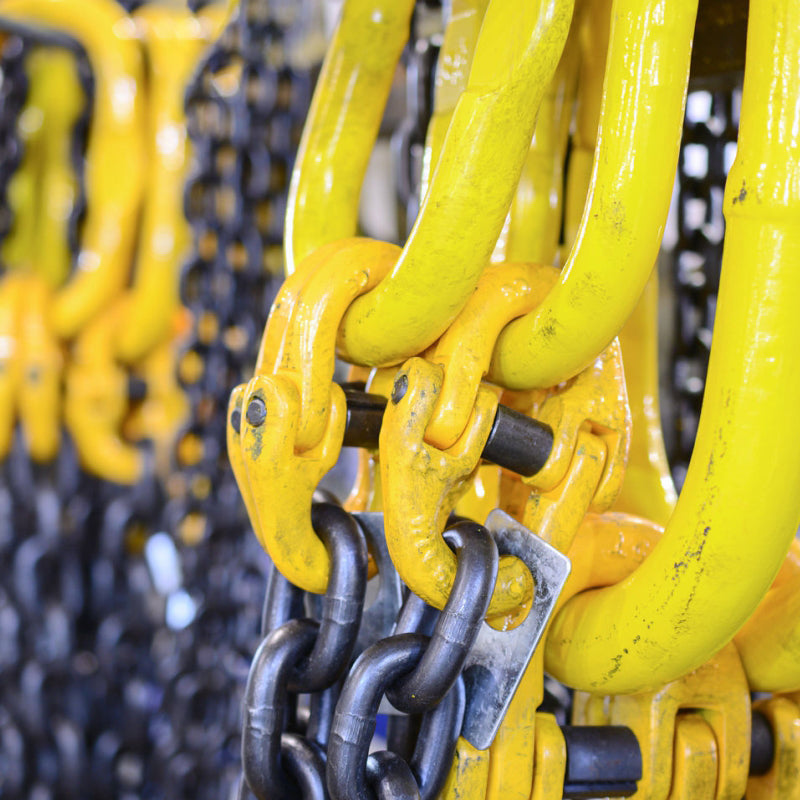
- Chain legs — the Grade 80 short link chain in each leg carries the individual leg load. Link diameter determines the single-leg WLL per BS EN 818-4 component tables
- Master link — the master link connects the crane hook to the leg assembly. Its WLL must equal or exceed the total assembly SWL
- Master link assembly — the master link assembly on 3-leg and 4-leg configurations carries all leg forces simultaneously
- Hooks — each hook WLL must match the individual leg WLL. A hook rated below the leg WLL limits the assembly to the hook's lower rating
- Connecting links — chain connecting links used to join leg sections carry the full leg load and must be rated to the same WLL as the chain leg
A single-leg chain with a 3.15 tonne WLL chain and a 2.5 tonne WLL hook has an assembly SWL of 2.5 tonnes, not 3.15 tonnes. The weakest component governs the system rating.
Frequently Asked Questions
Does adding more legs always increase the SWL?
No. A four-leg chain carries the same SWL as a 3-leg assembly under BS EN 818-4. The fourth leg provides redundancy and stability, not additional load capacity.
What happens to SWL when a chain leg is shortened using a grab hook?
Shortening a leg with a grab hook does not change the chain WLL but changes the sling angle at the master link. A shorter leg increases the sling angle, which reduces the mode factor and decreases assembly SWL accordingly.
Can a multi-leg lifting chain be used for asymmetrical loads?
Yes, with calculation. The leg nearest the load's centre of gravity carries a disproportionate share. Each individual leg must carry a WLL above the maximum force it receives in the asymmetrical configuration, not just the average load per leg.
How does shock loading affect a multi-leg chain SWL?
Shock loading generates dynamic forces that exceed static SWL by 200% to 300%, as referenced in LEEA Code of Practice 6. The SWL stamped on the chain applies to static or controlled dynamic lifts only. Sudden load application, dropped load arrest, or impact loading requires a derated SWL or a higher-rated chain assembly.
Does chain diameter affect SWL calculation or only the base WLL?
Chain diameter determines the single-leg WLL, which is the base value for all SWL calculations. A larger diameter increases the single-leg WLL. The mode factor and sling angle calculations apply identically to all diameters. The assembly SWL scales proportionally with the single-leg WLL across all diameters and configurations.
Conclusion
SWL calculation for multi-leg lifting chains follows a fixed mathematical process: single-leg WLL multiplied by the mode factor for the leg count, adjusted for sling angle using the cosine function. Every increase in sling angle above 45° reduces the assembly SWL below the value printed on the test certificate. A 2-leg assembly at 60° carries the same SWL as a single vertical leg. A 3-leg assembly at 60° loses 29% of its rated capacity compared to the same assembly at 45°.
Load distribution across legs is only equal in perfectly symmetrical lifts. Asymmetrical loads increase the force on individual legs above the average calculated value. The master link assembly carries the combined force of all legs and must be rated to the full assembly SWL. Every component in the chain, from the Grade 80 short link chain to the hook and connecting links, governs the assembly SWL at its individual rated limit.
The Ratchet Shop supplies lifting chains in single, two, three, and four leg configurations, certified to BS EN 818-4 and tested to 2.5 times WLL before dispatch. Every assembly ships with a Certificate of Thorough Examination and full test documentation. For SWL calculations specific to your chain grade, link diameter, and lift geometry, contact The Ratchet Shop directly.


