


Contents7 sections
Every equipment has unique properties and limitations that should be taken into consideration before employing it in a real setting.
The following are the mentioned 5000 kg ratchet strap mistakes that every worker needs to avoid:
- Overload the ratchet strap without knowing how much weight it can bear.
- Use excessive force while lashing a load with a ratchet strap.
- Forget to calculate the total weight of the load before lashing.
- Use hooks incorrectly while attaching them to the anchor point.
- Tying knots at the heavy-weight ratchet strap when a lightweight load is secured.
Most of the time during the pressure, workers neglect to read the mentioned size and length of the ratchet strap, which will lead to serious consequences. So, through this blog, you will understand the steps taken to avoid blunders when using 5000 kg ratchet straps.
Ignoring Break Force
Break force is defined as the maximum weight that a strap can withstand, which is indicated in terms of (kg). For example, 5000 kg ratchet straps can tolerate a weight approximately equal to a small passenger car or an adult Asian elephant.
It means that putting more load than this might break the strap during transportation, which could damage the property or a person.
Lashing Capacity Is Never Counted
A force that is applied on a strap, and it will not break as a result of this, which is considered the lashing capacity. If a ratchet strap has a breaking force of 5000 kg, then the lashing capacity is half of it, which is 2500 daN.
Ignorance of this can result in legal and physical injuries beyond your imagination. However, workers mixed the terminologies like the mentioned weight with its lashing capacity and thought it would work well. Other than this, they forget to properly check the strap for any cuts on the webbing.
These common mistakes while using ratchet straps have become the reason for unbearable consequences.
Most importantly, while using a strap for securing a load, keep in mind the angle (between the strap and a specific reference plane), because the direction at which you are applying tension has a significant impact. Hence, the greater the angle is, the greater the lashing capacity required.
Calculation of a Load Weight Is Not Prioritised
This is the most important thing that workers did not count on the list. In case you are utilising a 5000kg ratchet strap and the load that needs to be secured is less than its breaking force, the left webbing will be tangled up, which could hurt the cargo or someone else.
In another scenario, if a 5000kg ratchet strap is going to tighten up the heavy load, which is ten times more than it can bear, it will also give negative outcomes for sure. Therefore, instead of transporting your load at risk, isn’t it better to calculate your cargo weight and then employ an accurate ratchet strap accordingly?
Prevention of 5000kg ratchet strap mistakes is better despite facing unpredictable situations.
Inappropriate Hook Attachment
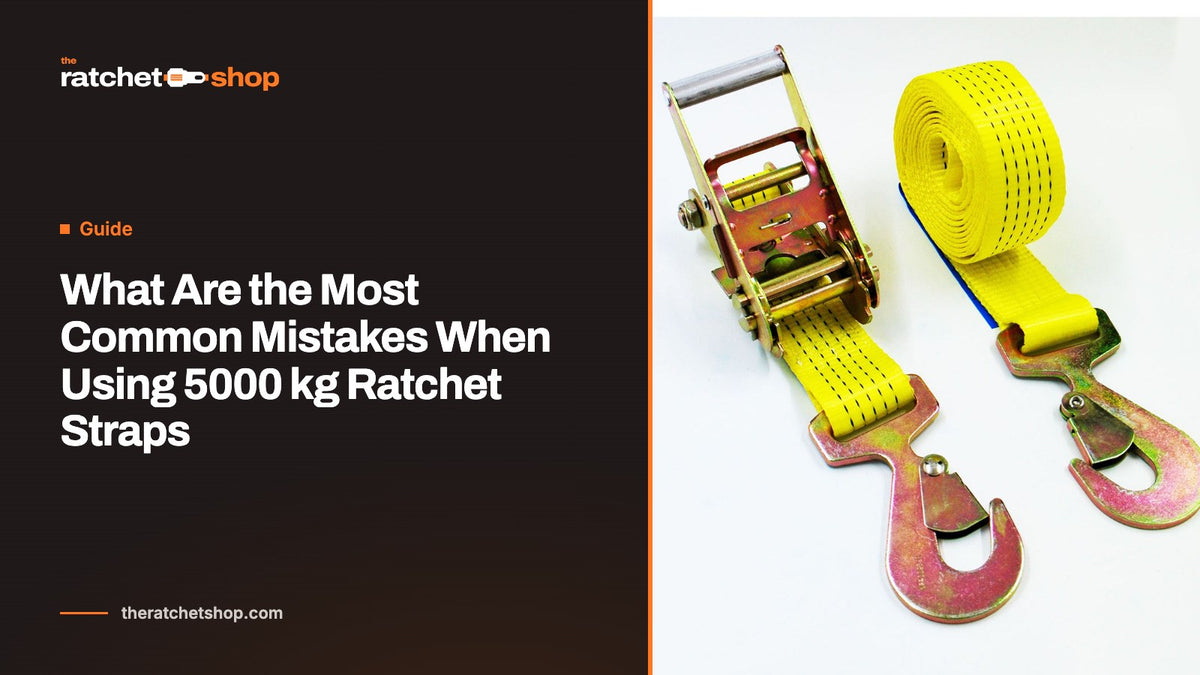
Usually, workers try to attach the J-hook base of a strap to a large bar or an anchor point, which will cause the hook to open under pressure.
Moreover, the 5000kg ratchet strap hook should not connect with a weak anchor point of a vehicle. Inspection of every single attachment point is important, as a bent or rusty point might make your load slip out from the truck.
Before linking the load to the rated recovery points, it is ideal to check the weight limit of your ratchet strap.
Be Aware:
Avoid using rope hooks on a vehicle for securing cargo, as they are not meant for heavy loads.
Tying Knots is Thought To Be Easy
Joining the leftover webbing of a ratchet strap is what every worker thinks is the simplest thing to do. But the reality is contrary, since the tied knot can create stress on concentration points, which minimises the 50% breaking limit of the strap and causes damage to the webbing.
These tangled webbings can loosen up and might cause your load transportation to fail completely.
However, just preventing these common mistakes while using a ratchet can make your handling of all sizes of cargo smooth and efficient.
At The Ratchet Shop, you can easily buy 5000 kg premium ratchet strap, which is made from 100% polyester material and conforms to EN12195-2:2001 safety performance requirements.
What are the questions that people have for The Ratchet Shop?
What happens if I exceed the 5000 kg break force of a ratchet strap?
If you overload the strap beyond its rated break force, it can snap during transport, which puts both people and cargo at serious risk. Always confirm the load weight before securing it and never exceed the published rating.
Why do I need to know the difference between break force and lashing capacity?
Break force refers to the maximum weight the strap can withstand before breaking, while lashing capacity is typically half of that value. For example, a 5000 kg break force strap usually has a 2500 daN lashing capacity. Using the wrong number for calculations can lead to structural failure and legal issues.
Do I really have to calculate the weight of my cargo?
Yes, failing to calculate load weight is one of the most common mistakes. If the load is too heavy, the strap can fail. If the load is too light and leaves excessive loose webbing, it can create trip hazards, damage cargo, or come undone in motion.
Can I tie knots in a 5000 kg ratchet strap to secure the extra webbing?
No, among 5000 kg ratchet strap mistakes, tying knots is a major one. This reduces the strap’s strength by up to 50% and creates stress points that can cause tearing. Instead, roll the excess webbing neatly and secure it using the strap’s built-in retainers or separate webbing ties.
Why is proper hook placement so important?
Incorrect attachment, such as hooking to weak, bent, rusted, or the wrong anchor points, can cause the hook to open or slip. Always attach J-hooks to a rated recovery point that can handle the strap’s load and check all connection points before transport.
Conclusion
Using 5000 kg ratchet straps effectively is crucial for protecting both your cargo and the people around you. By avoiding common mistakes while using ratchet straps, such as overloading the strap, misjudging weight limits, attaching hooks inappropriately, or making knots in the webbing, you ensure safer and more efficient load securing. Serious mishaps can be averted without neglecting break force, lashing capacity, and appropriate handling.
So, with the necessary equipment and best practices in place, every journey becomes more secure and stress-free. Visit The Ratchet Shop website and secure your load with safe ratchet straps.


