


Contents6 sections
Every part of a lifting chain is constructed using different grades of alloy steel. Dependent upon the capacity of a chain to withstand the weight of the load, an expert assigned the grades to the lifting chains.
What is a Grade of Alloy Steel?
The grades of Alloy steel are defined based on what they are composed of and how much strength they have to be safely utilised in industrial applications. Therefore, it is crucial to select the appropriate grade of steel, because the higher the grade, the stronger the steel.
How are the grades of Alloy Steel constructed?
The reason why Alloy steel is considered superior among other steels is because of its coordination with nickel, copper, and aluminium, which adds toughness, weldability, and corrosion resistance.
The experts initially produced Alloy steel through melting iron and other alloying materials, as mentioned above, in a furnace.
Then it undergoes the process of refining and casting.
Afterward, the procedure of tempering and quenching began, in which the steel was heated, then cooled to increase hardness, and reheated to a lower temperature.
Furthermore, slow cooling eliminates the internal stress and enhances the finishing of the steel.
This is how Grade 80 and Grade 100 are made to ensure they can absorb shock loads without cracking.
Difference Between Grade 80 and Grade 100 Lifting Chain
Every grade has its own slightly distinct heat treatment process and concentrations of alloying components. However, the number that is mentioned in the grade is the true representation of tensile strength.
Grade 80: minimum tensile strength of 800 N/mm².
Grade 100: minimum tensile strength of 1000 N/mm².
Based on the demand of the lifting task, a choice must be made. But in the comparison, Grade 80 lifting chains are widely used because of cost-effectiveness and proven reliability.
Hence, both grades are ideal for overhead lifting in which safety is always the priority.
3 Factors to Select The Best Equipment
It is suggested that before purchasing any equipment, it is better to consider:
- Strength
- Breaking load
- Marking
The Ratchet Shop is the ideal company if you are looking to buy genuine and proof-tested lifting chains. All the properties of a particular piece of equipment are explicitly mentioned.
For instance:
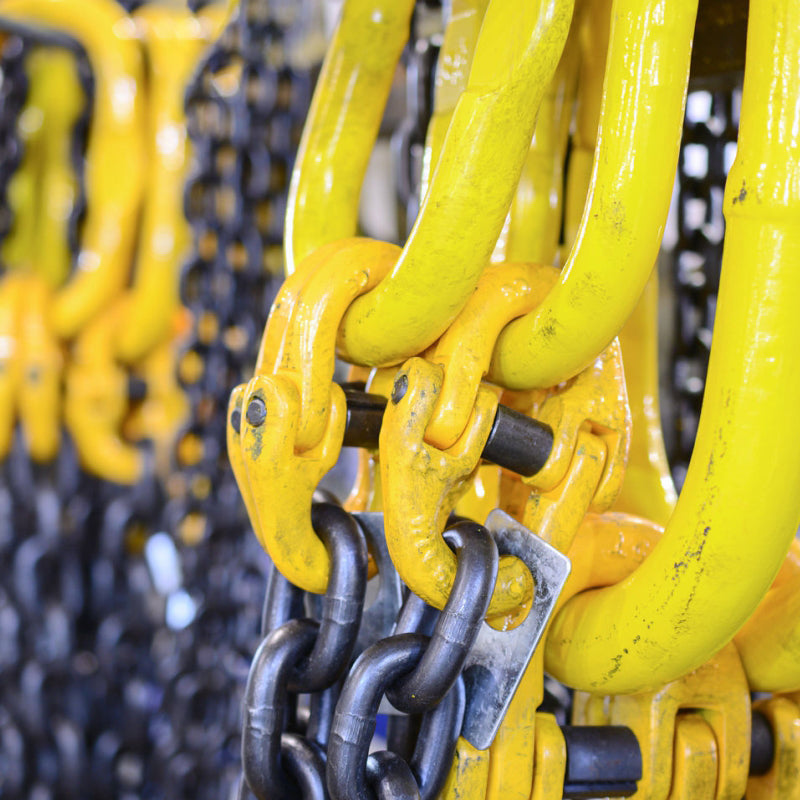
If you select a 13mm Four Leg Lifting Chain, then it will come with a minimum breaking strength that is 4 times the WLL (Working Load Limit). Moreover, it is proof tested to 2.5 times the WLL. In simpler terms, the equipment has gone through a controlled test where the applied force is 2.5 times higher than the maximum load it can safely handle.
Advantages of Relying on Grade 80 Lifting Chain
- Grade 80 lifting chain provides a maximum strength-to-weight ratio, so your load will be easily managed.
- It can bear the repeated loading cycles. So, no disruption was created during the construction project.
- It does not require any additional maintenance as this Grade 80 lifting chain, which has premium alloy steel, can survive hot temperatures and a harsh working environment.
- To avoid the falling of loads and cause of serious incidents during overhead lifting, the employment of Grade 80 lifting chain is compulsory.
During construction, moving, positioning, and installing heavy, large, or bulky materials is a vital part. For that reason, businesses demand safety and efficiency during construction work, and now that can be achieved through choosing The Ratchet Shop’s lifting chains.
So, by matching the Working Load Limit (WLL) to the load weight, you can select the perfect equipment.
What are the questions that people have for The Ratchet Shop?
What do the grade numbers on lifting chains actually mean?
The grade number represents the chain's minimum tensile strength in N/mm². Grade 80 means 800 N/mm², and Grade 100 means 1000 N/mm². The higher the number, the stronger the chain.
Which lifting chain grade should I use for my construction project?
Grade 80 is commonly utilised because it balances toughness with reliability and is considered cost-effective. Only upgrade to Grade 100 if your lift requires a higher capacity.
How do I know if a lifting chain is safe to use?
Check for clear manufacturer and grade markings, working load limit (WLL), and proof test authentication. Never use a chain that is unmarked, damaged, corroded, or stretched.
How often should lifting chains be inspected?
Visually inspect before every use. A formal inspection by a competent person should be carried out every 6 months, or more frequently in harsh environments.
Can lifting chains be used in extreme temperatures or harsh environments?
Yes, Grade 80 and Grade 100 chains are designed for harsh conditions. Based on their heat treatment, they are suitable for use in temperatures from -10 °C to 150 °C.
Conclusion
Selecting the appropriate lifting chain is a safety consideration as much as a technological one. Knowing what each grade has to offer, whether you choose Grade 80 or Grade 100, guarantees that your team can operate risk-free and with confidence.
Although Grade 80 is still a reliable and affordable option for the majority of building applications, the best equipment is always the one that meets your unique load needs. So, reach out to The Ratchet Shop, because it provides lifting chains that have been proven to work when it counts most, making that decision easier.


