


Contents12 sections
Lifting chains carry certified load limits that change based on chain grade, leg count, and sling angle. A single-leg Grade 8 chain with a 10mm link diameter carries a WLL of 3.15 tonnes. A 2-leg configuration at 0° to 45° increases that to 4.4 tonnes. A 3-leg configuration reaches 6.6 tonnes. These values are not fixed. Sling angle, temperature, wear, and shock loading all reduce the effective WLL below the stamped rating. Understanding how load limits are calculated and what reduces them is the baseline requirement for safe and legally compliant lifting operations in the UK.
What Are Lifting Chains Used For?
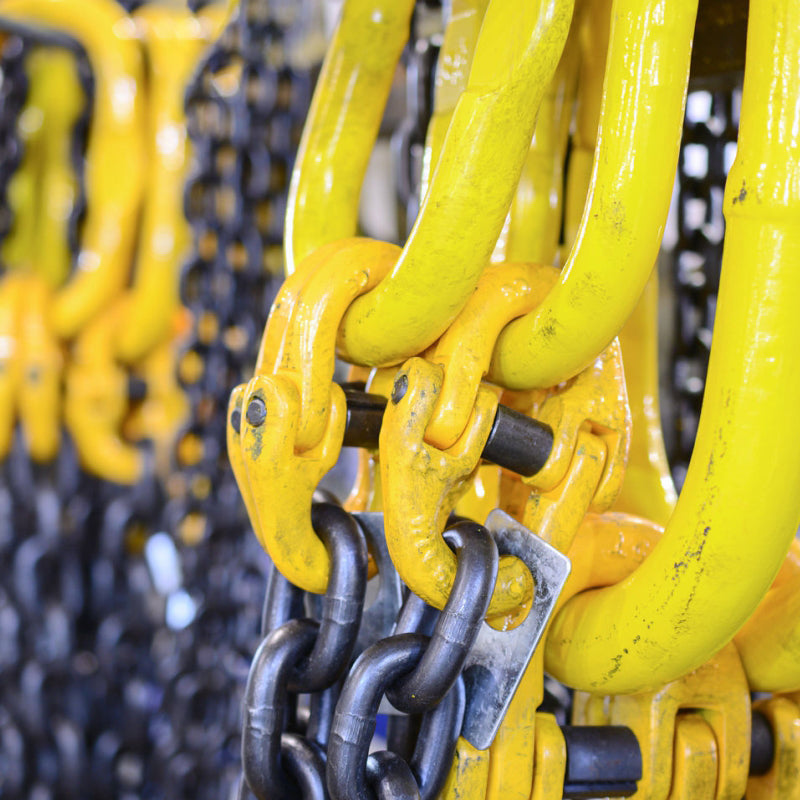
Lifting chains are steel load-bearing assemblies used to suspend, hoist, or transfer loads vertically or at an angle in industrial, construction, and transport environments. Grade 8 and Grade 10 alloy steel chains are the two primary types used in certified lifting operations across the UK. The Ratchet Shop supplies both grades, made to order and certified to BS EN 818-4.
What Does WLL Mean on a Lifting Chain?
WLL stands for Working Load Limit. It is the maximum load a lifting chain is rated to carry under normal conditions of use. WLL is expressed in tonnes and stamped on every certified lifting chain component. The WLL accounts for a safety factor of 4:1, meaning a chain rated at 1 tonne WLL has a minimum breaking force of 4 tonnes. WLL and SWL (Safe Working Load) are used interchangeably in BS EN standards, though WLL is the current preferred term under LOLER 1998.
What Is Proof Load and How Does It Relate to WLL?
Proof load is the test force applied to a lifting chain during manufacture to verify structural integrity before certification. Proof load is set at twice the WLL for Grade 8 chain, as specified in BS EN 818-4 Table 4. A chain with a WLL of 3.15 tonnes is proof loaded to 6.3 tonnes during production. The chain must sustain this load without permanent deformation or fracture. Proof load, WLL, and breaking force are all recorded on the test certificate that ships with every certified chain assembly. These 3 values together confirm that the chain meets the 4:1 safety factor required under LOLER 1998.
How Is the WLL Calculated for a Single-Leg Lifting Chain?
The WLL of a single-leg chain equals the rated capacity of the individual chain grade with no mode factor applied. A single-leg Grade 8 chain with a 10mm link diameter carries a WLL of 3.15 tonnes, as defined in BS EN 818-4 component tables. No angle reduction applies to a single vertical leg.
How Does a Multi-Leg Chain Sling Change the Load Limit?
A multi-leg chain sling distributes load across 2 legs, 3 legs, or 4 legs, increasing total WLL through a mode factor. The mode factor changes based on leg count and sling angle. There are 3 primary multi-leg configurations:
- 2-leg chain sling — mode factor 1.4 at 0° to 45°, giving 140% of single-leg WLL
- 3-leg chain sling — mode factor 2.1 at 0° to 45°, giving 210% of single-leg WLL
- 4-leg chain sling — treated as a 3-leg configuration under BS EN 818-4, mode factor 2.1
A 10mm Grade 8 single-leg chain rated at 3.15 tonnes produces a 2-leg WLL of 4.4 tonnes and a 3-leg WLL of 6.6 tonnes at 0° to 45° sling angle.
What Is the Sling Angle and Why Does It Reduce WLL?
The sling angle is the angle formed between the chain leg and the vertical axis of the load. As sling angle increases beyond 45°, the force each leg carries increases while the vertical lifting component decreases, reducing the effective WLL. BS EN 818-4 defines 3 critical angle bands:
|
Sling Angle |
Mode Factor (2-Leg) |
WLL Effect |
|
0° to 45° |
1.4 |
Full rated capacity |
|
45° to 60° |
1.0 |
Reduced to single-leg equivalent |
|
Above 60° |
Below 1.0 |
Significant WLL reduction |
|
Above 90° |
Prohibited |
Do not use |
A 2-leg chain sling used at 60° carries the same WLL as a single-leg chain, not double. Operators who ignore sling angle reduce WLL by up to 50% without any visible warning.
How Do You Calculate the WLL of a 2-Leg Chain Sling?
WLL (2-leg) = Single-leg WLL x Mode Factor
The mode factor is derived from the sling angle using this formula:
Mode Factor = cos(sling angle) x 2
For a 10mm Grade 8 chain at 30° sling angle:
- Single-leg WLL = 3.15 tonnes
- Mode factor = cos(30°) x 2 = 0.866 x 2 = 73
- 2-leg WLL = 3.15 x 1.73 = 45 tonnes
The LEEA (Lifting Equipment Engineers Association) Code of Practice 6 provides certified calculation tables for all standard grade and diameter combinations.
What Safety Factor Applies to Lifting Chains Under UK Law?
LOLER 1998 (Lifting Operations and Lifting Equipment Regulations) requires all lifting chains to carry a minimum safety factor of 4:1, meaning the minimum breaking force is 4 times the WLL. LEEA and BS EN 818 standards reflect this requirement. LOLER also requires:
- Thorough examination every 6 months for lifting chains in regular use
- Written examination records kept for a minimum of 2 years
- Immediate withdrawal from service of any chain showing visible damage, corrosion, elongation, or worn links
Grade 8 chain links elongate by more than 5% before fracture, providing a visible pre-failure warning. Grade 4 carbon steel chain is used only for lashing and carries no certified WLL for lifting. It must not be used in overhead lifting operations.
What Are the UK Compliance Standards for Lifting Chains?
3 primary standards govern lifting chain compliance in the UK:
- BS EN 818-4 — Short link chain for lifting purposes, Grade 8
- BS EN 818-7 — Fine tolerance hoist chain for Grade T (Grade 10)
- LOLER 1998 — UK statutory instrument covering all lifting equipment in the workplace
The Ratchet Shop lifting chains are manufactured, tested, and certified to BS EN 818-4. Each chain assembly ships with a Declaration of Conformity and a test certificate identifying WLL, grade, batch number, and proof load. PUWER 1998 (Provision and Use of Work Equipment Regulations) also applies, requiring chains to be suitable for purpose and maintained in safe condition.
What Factors Reduce the WLL of a Lifting Chain in Use?
Chain grade is the primary fixed variable in WLL calculations. Beyond grade, 6 operational factors reduce the effective WLL of a lifting chain below its rated capacity during use:
- Sling angle above 45° — reduces mode factor and increases leg load per BS EN 818-4 angle tables
- Shock loading — dynamic forces during sudden lifts exceed static WLL by 200% to 300%, as referenced in LEEA Code of Practice 6 guidance on dynamic load amplification
- Temperature above 200°C — Grade 8 alloy steel loses tensile strength above 200°C; BS EN 818-4 Annex A specifies WLL derating of 10% per 50°C increment above this threshold
- Corrosion and wear — chain links worn beyond 10% of original link diameter require immediate withdrawal per LEEA inspection criteria
- Side loading on hooks — loads applied to the point or back of a hook rather than the bowl reduce hook WLL by up to 25%
- Knotting or kinking — a kinked chain link reduces WLL by up to 50% at the deformed point, as the cross-sectional geometry of the link is permanently altered under BS EN 818-4 rejection criteria
What Is the Difference Between Grade 8 and Grade 10 Lifting Chain?
Grade 10 chain carries a 25% higher WLL than Grade 8 chain of the same diameter. A 10mm Grade 10 chain carries a WLL of 4.0 tonnes, compared to 3.15 tonnes for 10mm Grade 8. Grade 10 chains are lighter by approximately 20% for equivalent WLL, reducing operator fatigue in multi-shift applications. Both grades require BS EN certification and 6-monthly LOLER examination under UK law.
Frequently Asked Questions
Can I use a 4-leg chain sling to lift more than a 3-leg sling?
No. A 4-leg chain sling carries the same WLL as a 3-leg sling under BS EN 818-4. The fourth leg acts as a redundancy leg, not an additional load leg. The WLL is not increased beyond the 3-leg mode factor of 2.1.
What happens if I exceed the WLL of a lifting chain?
Exceeding the WLL puts the chain into the zone between working load and proof load. Repeated overloading causes microscopic fatigue cracking in chain links. This is not visible during routine inspection. Link failure under overload is sudden and without warning. Under LOLER 1998, overloading lifting equipment is a legal breach and results in prosecution.
Does chain length affect WLL?
No. Chain length does not change the WLL of a lifting chain. WLL is determined by chain grade, link diameter, and configuration. A 1-metre and a 5-metre chain of identical grade and diameter carry the same single-leg WLL.
Can I repair a damaged lifting chain and return it to service?
No. A damaged, cracked, or deformed lifting chain must be withdrawn from service permanently. Welding, reshaping, or re-linking a chain leg invalidates its certification and removes its LOLER compliance. Replacement is the only legal option.
How often does a lifting chain need a LOLER examination?
A lifting chain used for lifting persons requires examination every 6 months. A chain used for general lifting also requires examination every 6 months as standard practice. A competent person specifies a shorter interval based on use frequency and operating environment where conditions demand it.
What does a chain test certificate include?
A chain test certificate includes the chain grade, link diameter, WLL, proof load applied during testing, batch or serial number, date of test, and the name of the certifying body. All Ratchet Shop lifting chains ship with a full test certificate and Declaration of Conformity as standard.
Is there a difference between a lifting chain and a lashing chain?
Yes. A lifting chain carries a certified WLL for overhead lifting and is manufactured to BS EN 818-4 or BS EN 818-7. A lashing chain, typically Grade 7 or Grade 4, is rated for load securing and restraint only. Using a lashing chain for overhead lifting is non-compliant with LOLER 1998 and unsafe.
Key Numbers for Multi-Leg Lifting Chain Load Limits
The minimum safety factor under LOLER 1998 is 4:1 across all certified lifting chains. For multi-leg configurations, a 2-leg sling at 0° to 45° applies a mode factor of 1.4, while a 3-leg sling at the same angle applies a mode factor of 2.1. A 4-leg chain sling is rated identically to a 3-leg configuration under BS EN 818-4 and does not increase the WLL further.
Sling angle is the most commonly overlooked variable in field operations. A sling angle above 60° reduces WLL significantly below the rated value, and any angle above 90° is prohibited under BS EN standards. Grade 8 chain links worn beyond 10% of their original link diameter require immediate withdrawal from service per LEEA inspection criteria.
The Ratchet Shop certifies all chain assemblies to BS EN 818-4 with proof loads verified at manufacture before dispatch. All lifting chains are made to order and ship with a full test certificate and Declaration of Conformity. For load calculations specific to your chain grade and configuration, contact The Ratchet Shop directly.


