


Contents9 sections
Just imagine you have just loaded expensive machinery onto your flatbed, cinched down your straps, and hit the motorway. Fifteen miles later, you glance in your mirror to see your cargo shifting dangerously. Your heart sinks. This nightmare scenario happens more often than you think, and it is usually down to one critical mistake: choosing the wrong ratchet strap for the job.
Securing heavy loads in the UK is not just a matter of best practice — it is a legal obligation. Under the Road Vehicles (Construction and Use) Regulations 1986 and the Department for Transport's Code of Practice: Safety of Loads on Vehicles, every operator is personally responsible for ensuring cargo is properly restrained throughout transit. Get it wrong and you are not just risking your cargo — you are risking your licence, your livelihood, and other people's lives.
So through this guide, you will learn exactly how to choose the right ratchet strap with confidence, from calculating load capacity the right way through to understanding your legal inspection duties before every journey.
Understanding Load Capacity: The Non-Negotiable Starting Point
The first rule of heavy load transport is simple: never underestimate weight. That "roughly two tonnes" estimate could easily be three once you factor in equipment, pallets, packaging, and moisture absorption in materials like timber.
Here is where many operators make a critical error. They match the strap's WLL exactly to their cargo weight and assume they are covered. In practice, your Working Load Limit — set at one-quarter of the strap's minimum break strength — is a ceiling, not a target. Lashing angle, uneven load distribution, and the dynamic forces your cargo experiences during braking and cornering all reduce your effective securing capacity well below the rated figure. On a long motorway run with hard braking events, the real forces acting on your straps can far exceed what a static weight calculation suggests.
For heavy loads, your combined WLL across all straps should comfortably exceed your cargo weight once these factors are accounted for. If you are transporting 3,000kg of steel beams, you need straps rated well above that threshold. The Ratchet Shop's heavy-duty range starts at 4,000kg WLL and extends to 5,000kg, with 50mm polyester webbing designed specifically to distribute pressure across substantial loads without cutting in or deforming softer cargo surfaces.
Why Lashing Angle Matters More Than the Label
This is the detail that most guides skip entirely, and it is the one that catches experienced operators out.
When a strap runs at an angle rather than straight down the side of your cargo, its effective WLL drops — sometimes significantly. A strap rated at 5,000kg WLL running at a 30° angle from horizontal delivers roughly 50% of that rated capacity in the vertical plane. At a 60° angle, you are working closer to full capacity. The flatter the angle, the harder each strap has to work, and the more straps you need to compensate.
This is precisely why EN 12195-1:2010 — the calculation standard for load securing on road vehicles — exists. Rather than relying on rules of thumb, it gives you a proper method for calculating the minimum number of lashings based on cargo weight, the friction coefficient between your load and the vehicle bed, and the lashing angles you are actually working with. For any load over 1,000kg on a commercial vehicle, running this calculation is the professional standard.
|
Lashing Angle (from horizontal) |
Approximate Effective WLL |
|
90° (vertical) |
100% |
|
60° |
~87% |
|
45° |
~71% |
|
30° |
~50% |
Keep this in mind when positioning your anchor points and routing your straps. Steeper is always better.
Calculating How Many Straps You Actually Need
Weight capacity tells only half the story. The number of straps matters just as much as their individual strength.
Standard practice suggests one strap per metre of cargo length, but for heavy or unstable loads, EN 12195-1:2010 provides a more reliable calculation-based approach that accounts for your specific cargo weight, friction, and lashing geometry. For a 4-metre load of construction equipment, four straps is an absolute minimum — and in most real-world configurations with non-ideal angles, six or eight is the safer choice.
Think about the forces during transport as well. When you brake hard, your cargo wants to continue forward. Sharp turns create lateral pressure. Every pothole sends a jolt through your entire tie-down system. Multiple straps share these forces, reducing stress on individual components and creating redundancy if one strap works loose over the course of a long journey. Loads that are heavier at one end — such as plant equipment with a front-mounted engine — need additional straps concentrated at that end to prevent pitching during hard braking.
Length Matters More Than You Think
Using a strap that is too short forces the webbing into a shallow lashing angle, which directly reduces effective WLL as shown in the table above. Pre-tensioning a near-fully-extended strap compounds this by fatiguing the webbing fibres before your journey has even started. Too much length and you are left with excess webbing that flaps in the wind, abrades against cargo edges, or catches on passing obstacles at speed.
Measure your tie-down path carefully: up one side of the load, across the top, and down the other side. Then add at least one metre for the ratchet mechanism and a clean anchor connection. The Ratchet Shop offers lengths from 4m to 20m, which means you can match your exact geometry rather than compromise with whatever happens to be on the shelf.
Webbing Width and Material: What the Spec Sheet Does Not Always Tell You
Many people focus on WLL and overlook webbing specification entirely. For heavy loads, both width and material matter.
Polyester is the industry standard for load securing webbing, and for good reason. Unlike nylon, polyester has very low stretch under load — typically around 3% at WLL — which means your lashing stays tight rather than gradually relaxing as the journey progresses. Polyester also holds up well against UV exposure, most acids, and fuel spills, though prolonged contact with alkalis, bleach, or concentrated petroleum solvents will degrade fibres over time.
The standard 50mm width handles most industrial applications reliably. Wider webbing spreads load pressure across a greater surface area, reducing point loading that can damage powder-coated steel, wrapped machinery, or timber. For particularly sensitive surfaces, pair your 50mm webbing with rubber-edged corner protectors or wear sleeves at contact points — this is standard practice on professional haulage operations and protects both your cargo and the strap itself from abrasion damage.
Hook Selection Changes Everything
J-hooks, flat hooks, D-rings, and endless configurations each serve distinct purposes, and choosing the wrong one creates unnecessary risk regardless of your WLL rating.
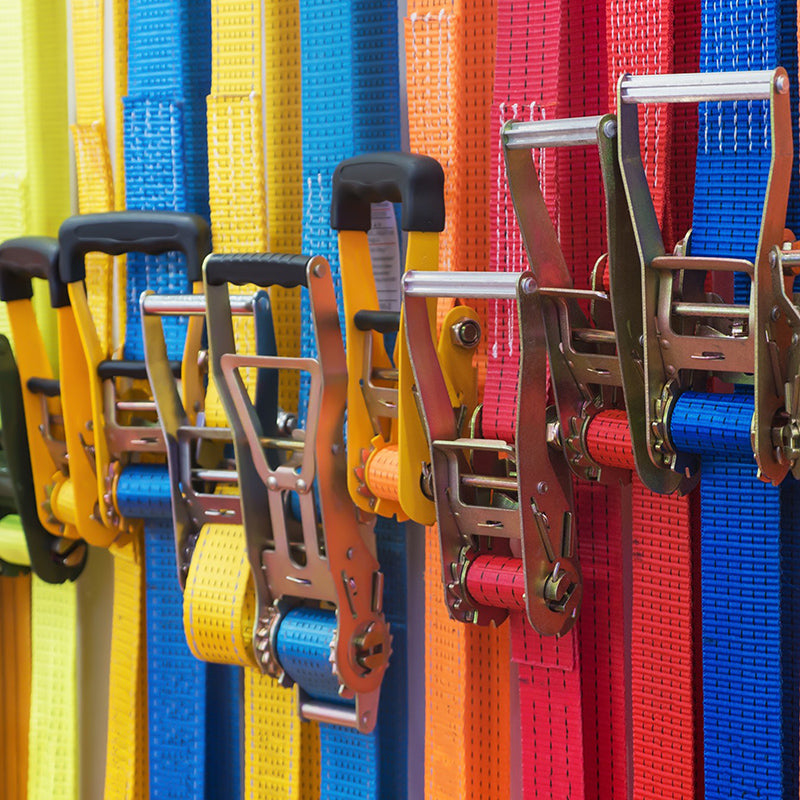
J-hooks are the most versatile option for general haulage work. They attach quickly to a wide range of anchor rail profiles and ring anchor points, which makes them the practical default for operators who carry varied loads. Flat hooks offer a wider contact surface and are less likely to disengage from certain anchor types under vibration.
D-rings offer a different advantage. They distribute force more evenly across the anchor point and work particularly well with permanent anchor systems built into flatbed trailers and curtainsiders. If you are repeatedly transporting similar loads on the same vehicle, D-rings provide consistent, reliable attachment with less operator variation between runs.
Endless straps eliminate hooks entirely, looping webbing around both the cargo and the anchor point in a continuous loop. This configuration is ideal for bundling applications — securing pipes, timber, or steel sections together — or in situations where metal hooks might scratch or indent a finished surface.
Whichever configuration you choose, check that the hook's rated WLL matches or exceeds the webbing's rated WLL. A high-rated strap with an undersized hook is only as strong as its weakest component.
Environment and Application: Durability Is Not a Luxury
Consider where and how you will use these straps across their working life. Daily commercial haulage in variable UK weather demands different specifications than occasional farm use in dry conditions.
Polyester webbing holds up well against UV and light chemical exposure, but metal components are the more vulnerable element in harsh environments. For marine applications — boat transport, port work, or coastal haulage — specify straps with hot-dip galvanised or stainless steel ratchet hardware. Salt spray degrades standard zinc-plated steel surprisingly quickly, and corroded ratchet teeth are a common cause of mechanism failure under load.
For operations involving oils, hydraulic fluids, or agricultural chemicals, inspect webbing condition more frequently than the standard guidance suggests. Contaminated webbing can look superficially fine while its tensile strength has been substantially reduced. When in doubt, replace rather than re-use.
Premium heavy-duty ratchet straps with individually certified components and protective storage bags offer considerably better long-term value for demanding applications. The marginal cost difference between economy and certified premium straps is negligible against the liability and replacement cost of a load loss incident on a UK road.
The Safety Standard — and Your Legal Inspection Duty
Every ratchet strap used for load securing on UK roads must conform to EN 12195-2:2001, which specifies performance and testing requirements for webbing lashings. This is not box-ticking — it is verification that your strap will perform as rated under the conditions it was designed for. Certification documentation should accompany each individual strap, recording its tested WLL and manufacturing batch details.
Beyond product certification, operators under the Provision and Use of Work Equipment Regulations 1998 (PUWER) have a legal duty to ensure that work equipment — including ratchet straps — is maintained in good working order and inspected at appropriate intervals by a competent person. In practice, this means a pre-use visual check before every journey and a more thorough periodic inspection if straps are in regular commercial use.
Withdraw any strap immediately if you find any of the following during inspection:
- Cuts, fraying, or abrasion through more than 10% of webbing width
- Stitching damage at end fittings or keeper loops
- Chemical staining, discolouration, or unusual stiffness in the webbing
- Bent, cracked, or corroded hooks or ratchet components
- Ratchet mechanism that does not lock positively or release cleanly
- Missing, illegible, or detached load rating label
Maintain a simple inspection log, particularly if straps are shared across multiple operators or vehicles. This costs nothing and demonstrates due diligence under both PUWER and HSE requirements.
Never use a damaged strap regardless of its original rating. A 5,000kg WLL strap with frayed webbing provides no meaningful load security and creates serious liability in the event of an incident.
Frequently Asked Questions
What is the difference between break strength and Working Load Limit (WLL)?
Break strength is the absolute maximum force before the strap fails under laboratory test conditions. WLL is the safe working capacity in real-world use, set at one-quarter of the break strength under EN 12195-2. Always work to WLL, never break strength. A strap with a 10,000kg break strength carries a 2,500kg WLL — the safety factor accounts for dynamic forces, wear, and operator variables that a static test cannot replicate.
How many ratchet straps do I need for my heavy load?
One strap per metre of cargo length is the baseline minimum, but this should always be verified against EN 12195-1:2010 calculations for commercial loads. A 6-metre machinery load should carry at least 6 to 8 straps in most configurations, with additional straps concentrated at the heaviest end of an unbalanced load. When in doubt, add more — the cost of an extra strap is nothing compared to the cost of a load loss incident.
Can I use multiple lighter-rated straps instead of fewer heavy-duty ones?
Technically the combined WLL adds up, but it is not recommended practice. Multiple lighter straps introduce more potential failure points, create a more complex and time-consuming setup, and are easier to mis-route under time pressure. Four 5,000kg straps provide better security and operational simplicity than eight 2,000kg straps for an equivalent load.
What strap length should I choose if I am unsure?
Measure the full path your strap will travel: up one side, across the top of the load, and down the other side to the anchor point. Add at least one to two metres for the ratchet mechanism and a clean connection. Slightly too long is manageable — slightly too short compromises your lashing angle and your WLL. Standard heavy-duty applications are covered by lengths between 4m and 15m.
Do I need different straps for different cargo types?
Not necessarily different WLL ratings, but different configurations add real practical value. J-hooks for fast, versatile attachment across varied loads. D-rings for permanent anchor systems on dedicated vehicles. Endless straps for bundling or protecting delicate finished surfaces. The WLL should always be matched to your cargo weight regardless of which style you select.
Conclusion
Selecting the right ratchet strap is part engineering calculation, part operational experience, and part legal compliance. Get your load weight right, account for lashing angles, use enough straps positioned correctly, choose the right webbing and hook configuration for your application, and inspect everything before every journey. These are not optional extras — under the Road Vehicles (Construction and Use) Regulations 1986, PUWER 1998, and DfT load securing guidance, they are your legal baseline.
Browse The Ratchet Shop's full range of EN 12195-2 certified heavy-duty ratchet straps — available in 4,000kg and 5,000kg WLL ratings with 50mm polyester webbing, in lengths from 4m to 20m. Every strap ships with individual certification documentation, ready for your inspection records and compliance files. Order for next-day UK delivery.


