


Contents9 sections
Marine lifting slings require specification beyond standard SWL ratings. Saltwater, UV radiation, biofouling, and dynamic tidal loading each reduce the effective SWL of a sling below its stamped capacity. Polyester webbing slings handle above-water marine lifts and retain 85% tensile strength after 500 hours of saltwater immersion. Grade 316 stainless steel wire rope slings are specified for subsea and continuous saltwater contact. Round slings rated to EN 1492-2 cover irregular load lifting on vessel decks and offshore platforms. Selecting the wrong sling type in a marine environment is a compliance failure under LOLER 1998 and a direct operational safety risk.
What Are Lifting Slings?
Lifting slings are flexible load-bearing assemblies used to attach a load to a crane, hoist, or lifting point for vertical or angled lifting operations. There are 4 primary sling types used in certified lifting operations:
- Webbing slings — flat polyester straps rated to EN 1492-1
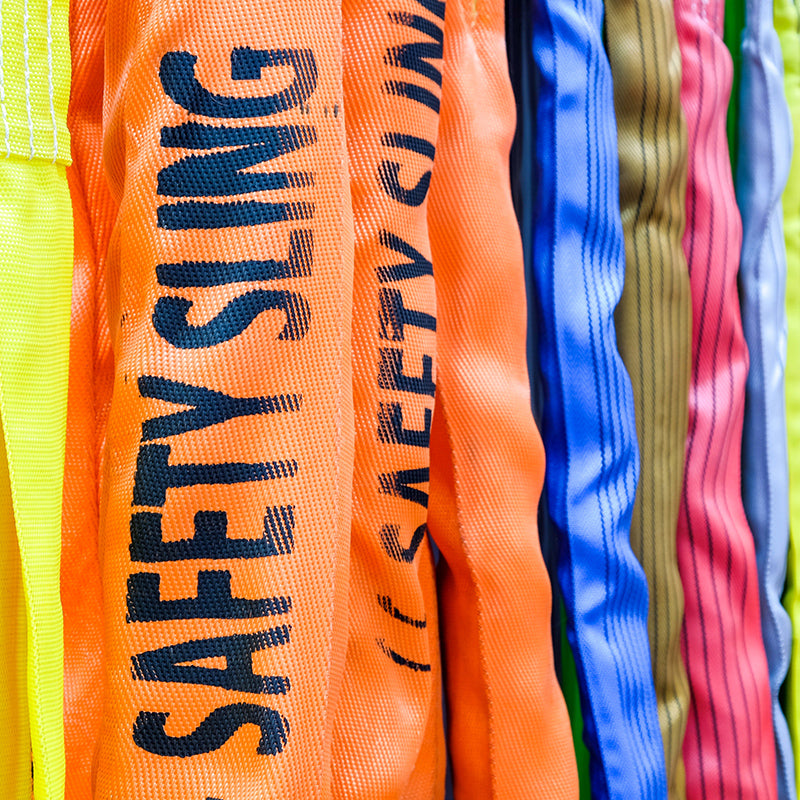
- Round slings — tubular polyester core with a protective sleeve, rated to EN 1492-2
- Wire rope slings — steel wire strand assemblies rated to EN 13414-1
- Chain slings — alloy steel link assemblies rated to BS EN 818-4
In marine applications, sling selection is governed by 2 additional factors beyond SWL: corrosion resistance and UV degradation resistance. A sling rated for general industrial use does not automatically qualify for marine environment use.
Why Are Marine Environments Different for Lifting Slings?
Marine environments expose lifting slings to 4 simultaneous degradation forces not present in standard industrial settings:
- Salt water immersion and spray — accelerates corrosion in steel components and degrades synthetic fibres
- UV radiation — breaks down polyester webbing at a rate 40% faster in coastal environments compared to indoor use, according to research from the Health and Safety Executive (HSE)
- Tidal movement and dynamic loading — creates shock loads that exceed static SWL by 150% to 200%
- Biofouling — marine organism growth on sling surfaces traps moisture and accelerates localised corrosion in metal fittings
Each factor reduces the effective SWL of a sling below its rated capacity if the correct marine-grade specification is not selected.
What Materials Are Used in Marine-Grade Lifting Slings?
3 materials dominate marine-grade lifting sling construction, each with distinct performance profiles:
Polyester Webbing
Polyester webbing slings carry 85% tensile strength retention after 500 hours of saltwater immersion, based on testing data cited in EN 1492-1 environmental performance notes. Polyester resists hydrolysis, meaning water absorption does not reduce fibre strength. Polyester webbing slings are the standard choice for above-water marine lifts including vessel deck operations and quayside cargo handling.
Polyester webbing slings are not suitable for submerged lifting operations where abrasion against hull surfaces or seabed materials is present.
High-Tenacity Polyester Round Slings
Round slings enclose a polyester load-bearing core inside a woven sleeve. The sleeve provides abrasion protection and UV shielding for the core fibres. Marine-grade round slings use a double-layer sleeve construction that extends service life by 30% compared to single-sleeve designs in coastal environments. Round slings rated to EN 1492-2 are the preferred choice for lifting irregular loads on vessel decks and offshore platforms.
Stainless Steel Wire Rope Slings
Grade 316 stainless steel wire rope slings provide full corrosion resistance in continuous saltwater exposure. Grade 316 contains 2% to 3% molybdenum, which increases pitting resistance in chloride environments compared to Grade 304 stainless steel. Wire rope slings rated to EN 13414-1 in Grade 316 are specified for subsea lifting, harbour dredging equipment, and offshore rig component handling where slings contact seawater directly.
Carbon steel wire rope slings are not compliant for marine use without hot-dip galvanisation and must be replaced, not retrofitted, when marine deployment is required.
How Does Corrosion Affect the SWL of a Lifting Sling?
Corrosion reduces SWL through 3 mechanisms, each measurable at inspection:
- Pitting corrosion — localised metal loss in wire rope slings reduces cross-sectional area. A 10% reduction in wire diameter reduces the wire tensile capacity by approximately 19%, as tensile strength is proportional to cross-sectional area
- Crevice corrosion — moisture trapped between sling components and fittings accelerates corrosion at contact points. Ferrule sleeves and master links are the 2 highest-risk locations in marine wire rope slings
- Galvanic corrosion — contact between dissimilar metals, such as carbon steel hooks on stainless wire slings, creates an electrochemical cell that corrodes the less noble metal. All fittings must match the sling material grade in marine assemblies
LEEA guidance states that any marine lifting sling showing visible corrosion, pitting, or discolouration on metal components requires withdrawal from service and competent person inspection before reuse.
What Are the Safety Requirements for Lifting Slings in Marine Use?
LOLER 1998 applies to all lifting slings used in UK waters, including offshore installations, port facilities, and vessel-based lifting operations. The Merchant Shipping (Lifting Operations and Lifting Equipment) Regulations 2006 extend equivalent requirements to commercial vessels under Maritime and Coastguard Agency (MCA) jurisdiction.
Safety requirements for marine lifting slings under these regulations include:
- SWL marked on every sling — colour coding per EN 1492-1 for webbing slings, or stamped tags for wire and chain slings
- Thorough examination every 6 months by a competent person, or more frequently in continuous marine use
- Pre-use inspection before every lift — checking for cuts, abrasion, UV degradation, corrosion, and deformation
- Rejection criteria applied at inspection — any webbing sling with cuts exceeding 10% of sling width, or any wire rope sling with more than 2 broken wires in one lay length, is withdrawn immediately
Dynamic marine lifts require a derating factor applied to SWL. Offshore industry practice, as referenced in DNV-ST-E271 (Det Norske Veritas standard for offshore lifting), applies a dynamic amplification factor of 1.3 to 2.0 depending on sea state and lift geometry. A sling rated at 5 tonnes SWL in static conditions carries an effective operational SWL of 2.5 to 3.8 tonnes in dynamic offshore lifting.
What Are the Main Use Cases for Marine Lifting Slings?
6 primary marine applications define lifting sling selection in UK operations:
- Quayside cargo handling — polyester webbing slings in vertical or choker configuration for containerised and general cargo. Vertical SWL applies directly with no mode factor reduction
- Vessel deck lifts — round slings in basket configuration for irregular or fragile loads including engines, pumps, and deck equipment. Basket configuration doubles the SWL compared to single vertical use
- Subsea equipment deployment — Grade 316 stainless wire rope slings for ROV frames, anchor equipment, and mooring chain deployment where slings enter the water column
- Offshore platform maintenance — multi-leg lifting chain or wire sling configurations for lifting structural components, machinery, and pipeline sections. 3-leg configurations apply a mode factor of 2.1 at 0° to 45° sling angle
- Boat and vessel lifting — boat lifting straps, a specialist form of webbing sling, used with travel lifts and crane hoists for vessel recovery and dry dock operations
- Harbour dredging and salvage — heavy-duty wire rope slings in Grade 316 for lifting submerged plant, debris, and salvage items from tidal and subtidal zones
How Do You Inspect a Marine Lifting Sling Before Use?
Pre-use inspection follows a 5-point check sequence for all marine lifting slings:
- Identification tag — confirm SWL, sling type, and EN standard are legible. A sling with an illegible or missing tag is withdrawn from service immediately
- Webbing or sleeve condition — check for cuts, abrasion burns, chemical staining, and UV bleaching along the full sling length. Polyester webbing exposed to excessive UV turns chalky and loses surface fibre definition before internal strength loss occurs
- End fittings — inspect hooks, shackles, and master links for corrosion, deformation, and gate function. A hook with a worn latch or bent point is withdrawn immediately
- Stitching and ferrules — check termination stitching on webbing slings for broken threads, and ferrule sleeves on wire slings for slippage or cracking
- Load history — confirm the sling has not been shock loaded, overloaded, or used outside its temperature rating. Polyester slings must not be used above 100°C or below minus 40°C per EN 1492-1
What Compliance Standards Apply to Marine Lifting Slings in the UK?
5 standards govern marine lifting sling compliance in UK operations:
|
Standard |
Scope |
|
EN 1492-1 |
Flat woven webbing slings for general lifting |
|
EN 1492-2 |
Round slings made of man-made fibres |
|
EN 13414-1 |
Steel wire rope slings |
|
LOLER 1998 |
UK lifting equipment law, all environments |
|
DNV-ST-E271 |
Offshore lifting equipment, dynamic operations |
The Merchant Shipping (Lifting Operations and Lifting Equipment) Regulations 2006 apply specifically to commercial vessel operations and require equivalent documentation to LOLER including thorough examination records retained for a minimum of 2 years.
All Ratchet Shop webbing slings and round slings are supplied with EN 1492-1 and EN 1492-2 certification respectively. Each sling carries an identification label showing SWL, sling class, and material type as required by UK supply chain compliance.
Frequently Asked Questions
Can a standard polyester webbing sling be used in saltwater?
Yes, with conditions. Polyester retains 85% tensile strength after prolonged saltwater exposure. The metal end fittings on standard webbing slings are typically carbon steel, which corrodes in marine environments. Marine-use webbing slings require stainless steel or hot-dip galvanised fittings. The sling body is suitable; the fittings determine marine compliance.
What colour is a 1-tonne lifting sling?
A 1-tonne SWL lifting sling is violet under EN 1492-1 colour coding. The full EN 1492-1 colour coding system runs from violet (1 tonne) through green (2 tonne), yellow (3 tonne), grey (4 tonne), red (5 tonne), brown (6 tonne), blue (8 tonne), and orange (10 tonne).
How long does a marine lifting sling last?
Service life depends on use frequency, environment, and storage conditions. EN 1492-1 does not specify a fixed service life. Slings used in continuous marine environments require 6-monthly LOLER examination as a minimum. Many offshore operators apply a 12-month maximum service life policy regardless of condition, replacing slings annually as a risk control measure.
Can lifting slings be repaired if damaged?
No. A damaged lifting sling must be destroyed and replaced. Cutting the sling prevents accidental reuse. Repairs, re-stitching, or splicing of lifting slings are not permitted under EN 1492-1 or EN 1492-2 and invalidate certification.
What is the difference between SWL and WLL on a lifting sling?
SWL (Safe Working Load) and WLL (Working Load Limit) refer to the same value on a lifting sling. WLL is the current preferred terminology under BS EN standards and LOLER 1998. Both values represent the maximum load the sling is rated to carry under normal conditions of use with a 7:1 minimum safety factor applied for synthetic webbing slings under EN 1492-1.
Do lifting slings need to be stored differently after marine use?
Yes. After marine use, lifting slings must be rinsed with fresh water to remove salt deposits, dried away from direct sunlight, and stored in a clean, dry environment away from UV exposure, heat sources, and chemicals. Salt residue accelerates UV degradation of polyester fibres and corrodes metal fittings between uses.
What is a boat lifting sling and is it the same as a standard webbing sling?
A boat lifting sling is a specialist wide-band webbing sling designed to support the full hull profile of a vessel during haulout and travel lift operations. Boat lifting slings are wider than standard lifting slings, typically 300mm to 600mm wide, to distribute load across the hull without point loading. They are not interchangeable with standard EN 1492-1 webbing slings and carry separate load ratings specific to vessel weight distribution.
Marine Lifting Sling Selection at a Glance
Sling material determines marine suitability before SWL is considered. Polyester webbing slings cover above-water operations at quayside and on vessel decks, certified to EN 1492-1 with stainless or galvanised fittings for marine compliance. Round slings in EN 1492-2 handle irregular and fragile loads on offshore platforms where basket configuration doubles the working SWL. Grade 316 stainless wire rope slings are the only compliant option for subsea and continuous saltwater contact applications under EN 13414-1.
Dynamic offshore lifts require SWL derating by a factor of 1.3 to 2.0 depending on sea state, as referenced in DNV-ST-E271. A sling rated at 5 tonnes in static conditions operates at 2.5 to 3.8 tonnes effective SWL in active offshore conditions. All marine slings require 6-monthly LOLER examination, stainless steel or hot-dip galvanised fittings, and fresh water rinse and dry storage after every marine deployment.
The Ratchet Shop supplies webbing slings and round slings certified to EN 1492-1 and EN 1492-2 for lifting and lashing applications across the UK. For marine-specific sling requirements, contact The Ratchet Shop directly for product and certification guidance.


