


Contents4 sections
Lifting slings are the primary load-bearing connection between a crane or hoist and the load being lifted. Selecting the wrong sling type, the wrong SWL rating, or the wrong configuration for a given industrial application reduces the system's safe working capacity and creates a LOLER 1998 compliance failure. Webbing slings, round slings, chain slings, and single-use slings each cover a specific range of industrial lifting conditions. Load weight, surface sensitivity, operating environment, and lift geometry determine which type is correct for each application. This guide covers all 4 sling types, their industrial use cases, SWL selection criteria, inspection requirements, and UK compliance standards.
What Are Lifting Slings Used for in Industrial Applications?
Lifting slings attach loads to cranes, hoists, and lifting appliances for vertical, basket, and choker hitch lifting operations in industrial environments. There are 4 primary sling types used in UK industrial operations:
- Webbing slings — flat polyester straps rated to EN 1492-1, used for loads with sensitive or polished surfaces
- Round slings — endless loop polyester core slings rated to EN 1492-2, used for irregular loads and precision lifts
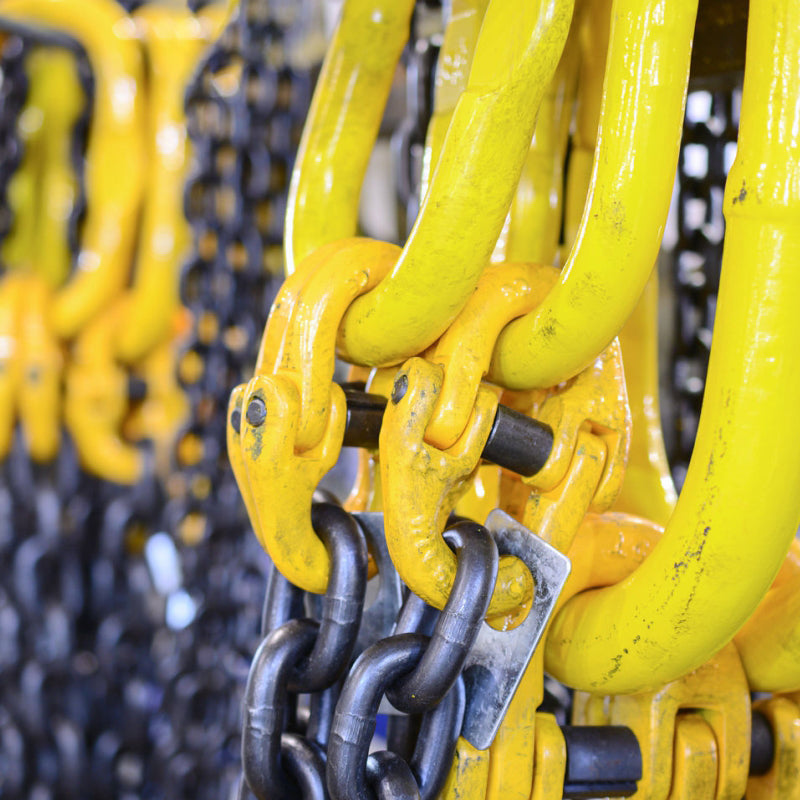
- Chain slings — Grade 80 or Grade 100 alloy steel assemblies rated to BS EN 818-4, used for high-temperature and heavy-duty industrial lifts
- Single-use slings — disposable polyester slings rated to EN 1492-1, used for one-time transport and installation lifts
Each sling type carries a 7:1 safety factor between SWL and minimum breaking force for synthetic slings under EN 1492-1 and EN 1492-2. Chain slings carry a 4:1 safety factor under BS EN 818-4.
What Are Webbing Slings and Where Are They Used Industrially?
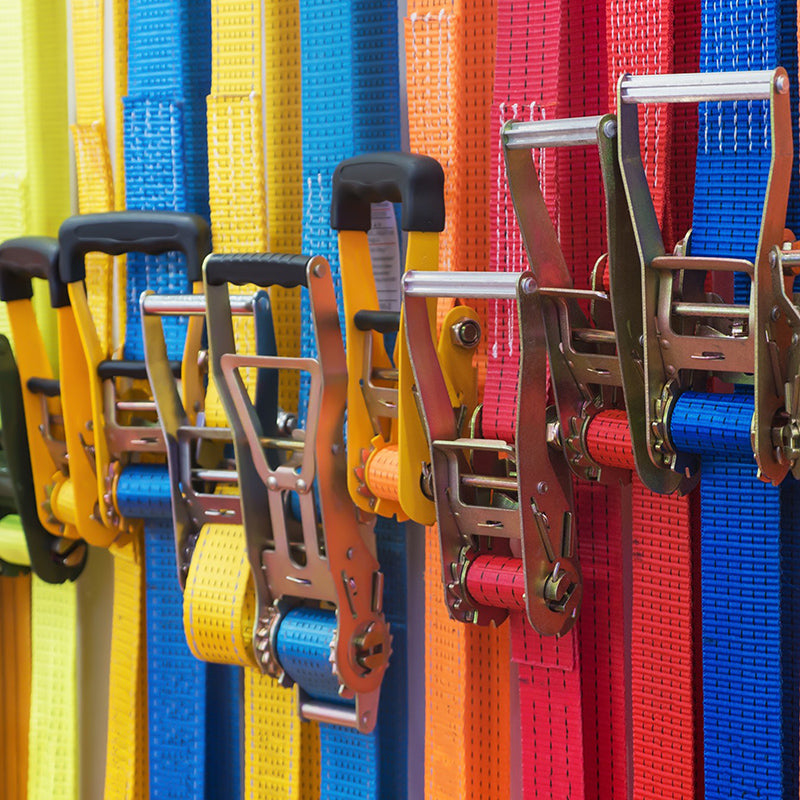
Webbing slings are flat woven polyester strap assemblies used to lift loads where surface protection, flexibility, and lightweight handling are required. 100% high-tenacity polyester webbing resists oil, grease, and most acids, maintaining fibre integrity across manufacturing, warehousing, and logistics environments.
Lightweight webbing slings cover SWL ratings of 1,000 kg, 2,000 kg, and 3,000 kg for standard industrial lifts including machinery installation, component handling, and warehouse stock movement. Heavyweight webbing slings cover SWL ratings of 4,000 kg, 5,000 kg, 6,000 kg, 8,000 kg, and 10,000 kg for structural, construction, and offshore cargo handling applications.
5 primary industrial applications use webbing slings:
- Manufacturing plant equipment lifts — machinery with finished surfaces requires webbing contact to prevent scratching and indentation during installation and repositioning
- Warehousing and distribution — flat webbing slings in choker configuration secure irregular palletised loads during crane transfer in high-bay warehouses
- Construction component lifting — precast concrete panels, glass units, and cladding elements require wide-surface sling contact to distribute load without point pressure
- Freight and cargo handling — webbing slings in basket configuration handle containerised and break-bulk cargo at UK ports and logistics terminals
- Boat and vehicle handling — wide webbing slings distribute load across hull and chassis surfaces during haulout, recovery, and positioning operations
All Ratchet Shop webbing slings comply with BSEN 1492-1:2000 and carry reinforced stitching at the becket eyes with colour-coded SWL identification on every label.
What Are Round Slings and Where Are They Used Industrially?
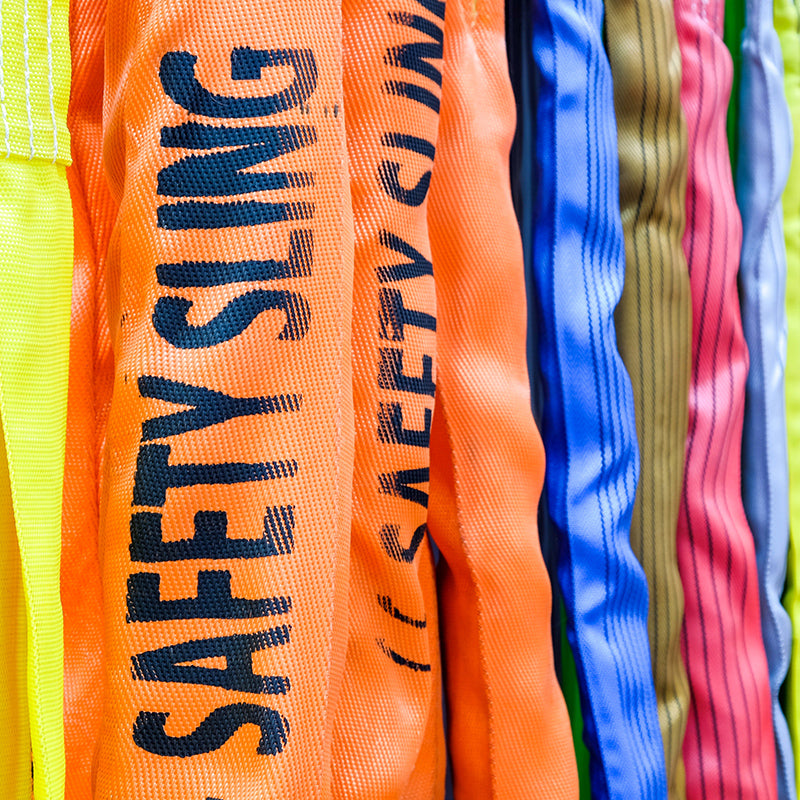
Round slings are endless loop slings constructed from continuous high-tenacity polyester fibres enclosed in a woven protective sleeve. The endless loop geometry distributes load evenly across all fibres simultaneously, producing a higher strength-to-weight ratio than flat webbing slings of equivalent SWL. The soft, cushioned contact profile reduces pressure points on sensitive load surfaces.
Lightweight round slings cover SWL ratings of 1,000 kg, 2,000 kg, and 3,000 kg. Heavyweight round slings cover SWL ratings of 5,000 kg and 8,000 kg for heavy structural and industrial machinery applications.
4 primary industrial applications use round slings:
- Precision machinery installation — CNC machines, turbines, and precision manufacturing equipment require round sling contact to prevent edge damage during positioning lifts
- Offshore platform maintenance — round slings in basket configuration handle irregular equipment including pumps, valves, and motor assemblies on offshore platforms
- Steel and structural fabrication — round slings wrap around steel sections and fabricated components without creating the flat-edge pressure that webbing slings produce on round profiles
- Lifting in confined spaces — the compact, flexible profile of a round sling passes through tight access points and around obstacles where flat webbing slings cannot be positioned correctly
All Ratchet Shop round slings comply with BSEN 1492-2:2000 and carry colour-coded SWL identification with full EN certification on every sling label.


