


Contents8 sections
Choosing the Right Shackle for Heavy Lifting Applications
A shackle is the most common single point of failure in a lifting assembly. Every lifting system that connects a sling, chain, or rope to a crane hook, spreader beam, or anchor point passes that load through a shackle. A shackle selected below the assembly WLL, installed incorrectly, or left unchecked for wear reduces the entire system's safe working capacity to its own degraded rating. Bow shackles and dee shackles cover the full range of heavy lifting applications in UK industry. Selecting between them, and selecting the correct WLL within each type, determines whether a lift is safe and legally compliant under LOLER 1998.
What Is a Shackle and How Is It Used in Heavy Lifting?
A shackle is a forged steel connector used to join lifting components including slings, chains, wire ropes, and hooks to a common load point or lifting appliance. Every shackle consists of 3 parts: a U-shaped body, a pin that closes the U across the open end, and a WLL marking stamped on the body.
Shackles carry load in 2 directions depending on type. A bow shackle carries load in multiple directions including lateral and angular loads. A dee shackle carries load in a single in-line direction. Selecting the wrong type for a multi-directional or angular lift reduces the effective WLL and introduces side loading that the shackle body is not rated to sustain.
Under BS EN 13889, the European standard governing forged steel shackles for general lifting purposes, every certified shackle carries a minimum safety factor of 4:1 between WLL and minimum breaking load. A shackle with a 5 tonne WLL has a minimum breaking load of 20 tonnes.
What Is the Difference Between a Bow Shackle and a Dee Shackle?
Bow shackles and dee shackles differ in body geometry, load direction capacity, and application range. If you want to understand the Difference Between Bow Shackles and Dee Shackles, selecting the right type starts with understanding these three key differences and how each affects safe lifting applications.
Body Geometry
A bow shackle has a rounded, omega-shaped body that widens at the bow, creating a larger internal clearance. A dee shackle has a narrow, D-shaped body with minimal internal clearance. The bow shackle body accommodates multiple sling legs, master links, and large-diameter chain components simultaneously. The dee shackle body accommodates a single sling eye, chain leg, or wire rope thimble.
Load Direction
A bow shackle sustains in-line, angular, and lateral loads without body deformation, as specified in BS EN 13889 for multi-directional lifting applications. A dee shackle sustains in-line axial loads only. A lateral or angular load applied to a dee shackle body creates a bending moment across the narrowest cross-section of the D, reducing the effective WLL by up to 30% depending on load angle, as referenced in LEEA Code of Practice 6.
Application Range
Bow shackles are used at master link connections in multi-leg lifting chain assemblies, at spreader beam end connections, and at any lifting point where 2 or more components connect simultaneously. Dee shackles are used for single in-line connections including wire rope end terminations, single-leg chain connections, and webbing sling eye connections where the load direction remains constant throughout the lift.
What WLL Do You Need for Heavy Lifting Applications?
WLL selection for a lifting shackle follows a 3-step process:
- Identify the maximum load — determine the total suspended load including the weight of the load, lifting accessories, spreader beams, and hook blocks. This is the gross lifted weight
- Apply the load factor — for dynamic lifts, shock loads, or lifts with significant side load components, multiply the gross lifted weight by a load factor of 1.3 to 2.0 as referenced in LEEA Code of Practice 6. For static vertical lifts, the load factor is 1.0
- Select the shackle WLL above the calculated load — the shackle WLL must equal or exceed the calculated load. Never select a shackle at exactly the calculated load. Select the next size above to maintain the design safety margin
For a 4 tonne static vertical lift: shackle WLL minimum is 4 tonnes. Select a 4.75 tonne bow shackle as the next standard size above.
For a 4 tonne dynamic lift with a load factor of 1.3: calculated load is 4 x 1.3 = 5.2 tonnes. Select a 6.5 tonne bow shackle as the next standard size above.
The Ratchet Shop supplies bow shackles and dee shackles in WLL ratings from 0.5 tonnes to 25 tonnes, covering light rigging through to heavy industrial and offshore lifting applications.
What Types of Shackle Pins Are Used in Heavy Lifting?
3 pin types are used in heavy lifting shackles, each suited to different operational conditions:
Screw Pin
A screw pin threads directly into the shackle body and tightens finger-tight. Screw pin shackles connect and release quickly without tools, making them the standard choice for temporary rigging, general construction lifts, and applications where the shackle is removed between lifts. Screw pins must be tightened to full thread engagement before every lift. A screw pin backed off by even half a turn reduces the shackle WLL to zero because the pin carries the full load only when fully engaged.
Safety Bolt Pin
A safety bolt pin passes through the shackle body and is secured by a nut and cotter pin. The cotter pin prevents the nut from loosening under vibration, rotation, or sustained dynamic loading. Safety bolt pin shackles are used for permanent or semi-permanent rigging arrangements, offshore lifting, and any application where vibration risks the screw pin backing out. The safety bolt pin cannot release accidentally under any loading condition while the cotter pin is in place.
Round Pin
A round pin passes through the shackle body without threads and is secured by a split pin or cotter pin. Round pin shackles are used in applications where the pin is not load-bearing in the axial direction, such as anchor attachment and mooring connections. Round pin shackles are not used for overhead lifting in UK industrial applications where BS EN 13889 compliance is required, as round pins without thread engagement do not satisfy the standard's pin retention requirements.
How Do You Install a Shackle Correctly for Heavy Lifting?
Correct shackle installation follows a 5-point procedure for every heavy lifting application:
- Confirm WLL before fitting — verify the WLL stamped on the shackle body equals or exceeds the calculated load for the lift. A shackle without a legible WLL marking is not used
- Orient the pin correctly — the shackle pin must be positioned so the load bears on the bow or body, not on the pin. A load applied directly to the pin reduces the shackle WLL by up to 50% as the pin is rated for shear, not bending
- Thread the pin to full engagement — screw the pin until the shoulder contacts the shackle body, then back off by one quarter turn to prevent galling. Confirm full thread engagement visually before the lift begins
- Mouse the pin on permanent rigging — on permanent or semi-permanent installations, secure the screw pin with a wire mouse through the pin eye and around the shackle body to prevent rotation under cyclic loading
- Confirm the sling or chain eye seats in the bow — the connecting component must seat fully in the bow or body interior. A component resting on the shackle crown rather than inside the body creates a point load on the narrowest cross-section of the shackle
How Do You Inspect a Shackle Before Use?
Pre-use inspection of shackles covers 4 check points before every lift, as required by LOLER 1998 and LEEA inspection criteria:
- Body deformation — check the shackle body for elongation, bending, and twisting. A bow shackle bow opening that has increased by more than 5% of the original internal width is withdrawn from service immediately
- Pin condition — check the pin for straightness, thread condition, and corrosion. A bent pin indicates a previous overload event. The shackle and pin are withdrawn together as the overload affects both components
- WLL marking legibility — confirm the WLL stamped on the body remains legible. A shackle with an illegible WLL marking is withdrawn until the WLL is confirmed against the original test certificate
- Wear at load contact zones — check the crown of the bow shackle and the body sides of the dee shackle for groove wear at sling and chain contact points. Wear exceeding 10% of the original material cross-section at any contact point is a rejection criterion per LEEA Code of Practice 6
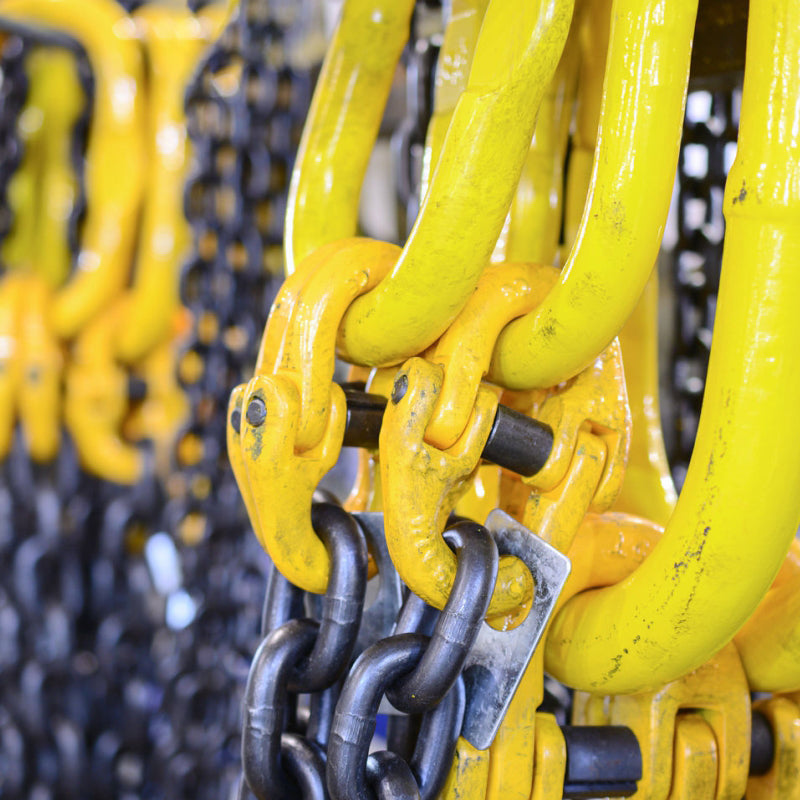
Shackles used in lifting chain assemblies, lifting sling connections, and material handling applications all require the same 4-point pre-use inspection regardless of the connected component type.
What UK Compliance Standards Apply to Lifting Shackles?
3 standards govern lifting shackle compliance in UK heavy lifting operations:
|
Standard |
Scope |
|
BS EN 13889 |
Forged steel shackles for general lifting purposes |
|
LOLER 1998 |
Lifting operations and lifting equipment, all UK workplaces |
|
PUWER 1998 |
Provision, use, and maintenance of work equipment |
All shackles used in UK lifting operations require UKCA or CE marking and a Declaration of Conformity identifying WLL, the EN standard, and the name of the certifying body. LOLER 1998 requires thorough examination of shackles used as part of a lifting assembly every 6 months by a competent person. Examination records are retained for a minimum of 2 years.
Frequently Asked Questions
Can a bow shackle be used sideways in a multi-sling connection?
Yes. A bow shackle sustains lateral and angular loads as specified in BS EN 13889 for multi-directional lifting. The bow geometry distributes load across the full internal radius of the body. A dee shackle must not be used in lateral load configurations as the narrow D-body is rated for in-line axial loads only.
What is the maximum angle for a sling connected through a shackle?
The sling angle at a shackle connection follows the same mode factor rules that apply to the sling assembly. A 2-leg sling at 60° angle produces the same effective load on each leg as a single-leg sling of equal WLL. The shackle WLL must account for the actual leg load at the working angle, not the assembly WLL at 0°.
Do shackles need to be replaced after a proof load test?
No. Proof load testing at 2 times WLL per BS EN 13889 is a manufacturing verification process. Shackles are proof loaded during production and returned to service with full WLL certification. A shackle that has sustained an unplanned overload above WLL in service is withdrawn and inspected by a competent person before any further use.
What is the difference between a galvanised shackle and a stainless steel shackle?
A galvanised shackle is a carbon steel or alloy steel shackle with a zinc coating providing corrosion protection. A stainless-steel shackle uses Grade 316 stainless steel throughout, providing full corrosion resistance in continuous saltwater or chemical exposure environments. Galvanised shackles are used in outdoor construction and general industry. Grade 316 stainless shackles are specified for marine, offshore, and food processing applications where the zinc coating of a galvanised shackle is insufficient or prohibited.
Conclusion
Shackle selection for heavy lifting begins with load calculation and ends with pre-use inspection. The calculated load including dynamic load factors determines the minimum WLL. The load direction, whether in-line or multi-directional, determines whether a bow shackle or dee shackle is correct. The pin type, screw pin for temporary rigging or safety bolt for permanent and dynamic applications, determines whether the connection remains secure under the operating conditions of the lift.
A shackle installed incorrectly, whether the pin is not fully engaged, the load bears on the pin rather than the body, or a dee shackle receives a lateral load, fails at a fraction of its rated WLL. These are not rare site errors. They are the 3 most common shackle misuse patterns identified in LEEA field inspection reports across UK construction and industrial lifting operations.
The Ratchet Shop supplies bow shackles and dee shackles in WLL ratings from 0.5 tonnes to 25 tonnes, certified to BS EN 13889 and compliant with LOLER 1998 and UKCA requirements. All shackles ship with a Declaration of Conformity and full test documentation. For shackle selection guidance specific to your lifting assembly configuration and load requirements, contact The Ratchet Shop directly.


