


Contents5 sections
Construction projects require lifting slings that match the load weight, surface type, lift geometry, and operating environment of every individual lift. A sling selected by weight alone, without accounting for hitch type, sling angle, and surface conditions, operates above its rated SWL on site without any visible warning. Webbing slings and round slings cover the full range of construction lifting applications from structural steel and precast concrete panels to glazing units and mechanical plant. Selecting the correct type, the correct SWL rating, and the correct configuration is a legal requirement under the Work at Height Regulations 2005 and LOLER 1998, not an operational preference.
What Types of Lifting Slings Are Used on Construction Sites?
3 lifting sling types cover construction site applications in the UK:
- Webbing slings — flat woven polyester straps rated to EN 1492-1, used for structural, cladding, and general construction lifts
- Round slings — endless loop polyester slings rated to EN 1492-2, used for precision machinery installation, pipe lifts, and irregular load handling
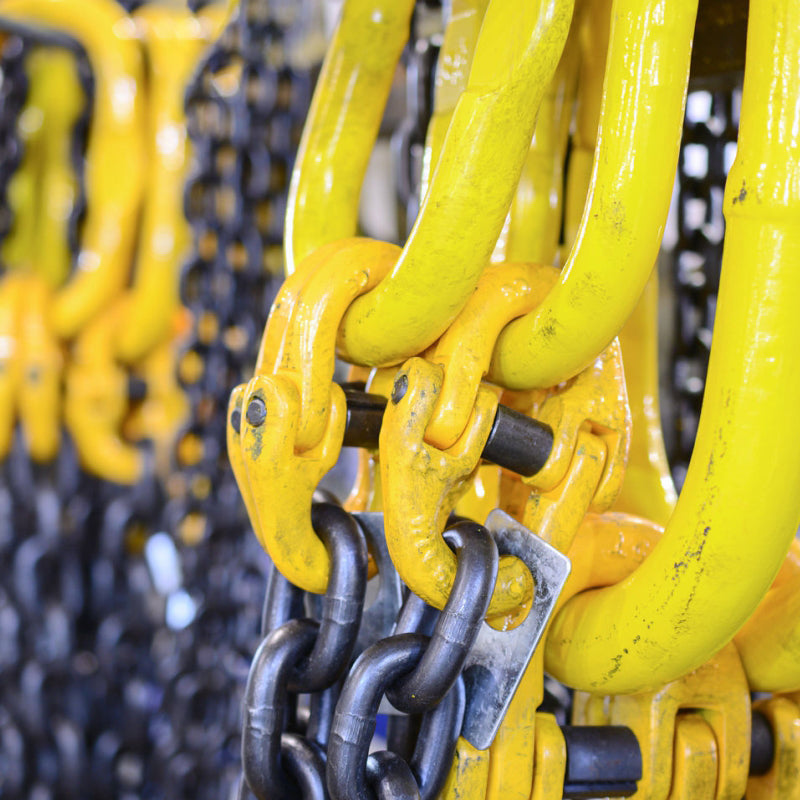
- Chain slings — Grade 80 alloy steel assemblies rated to BS EN 818-4, used for high-temperature applications and heavy structural lifts where synthetic slings are not suitable
Webbing slings and round slings carry a 7:1 minimum safety factor between SWL and minimum breaking force per EN 1492-1 and EN 1492-2. Chain slings carry a 4:1 safety factor per BS EN 818-4. The 7:1 safety factor on synthetic slings accounts for the higher susceptibility of polyester to edge cutting, UV degradation, and chemical exposure on active construction sites.
What Are Webbing Slings and When Are They Used in Construction?
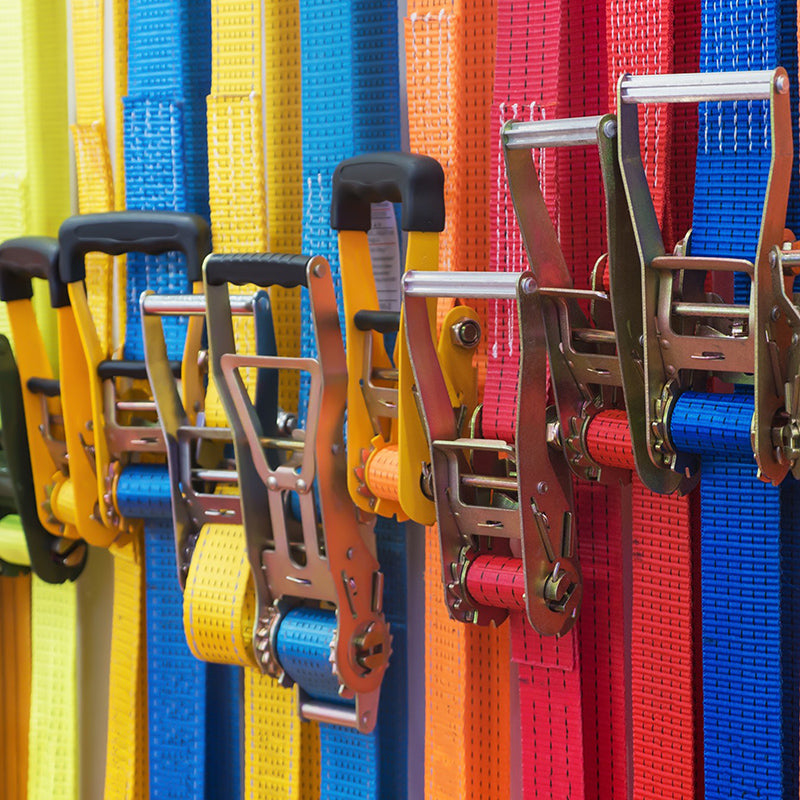
Webbing slings are flat woven polyester strap assemblies that distribute load across the full strap width during a lift. The flat contact profile spreads load over a wider surface area than chain or wire rope, reducing pressure on load surfaces and making webbing slings the standard choice for surface-sensitive construction materials.
The Ratchet Shop supplies webbing slings in 2 capacity ranges. Lightweight webbing slings cover SWL ratings of 1,000 kg, 2,000 kg, and 3,000 kg for standard construction lifts. Heavyweight webbing slings cover SWL ratings of 4,000 kg, 5,000 kg, 6,000 kg, 8,000 kg, and 10,000 kg for structural and heavy civil engineering applications.
5 construction applications specify webbing slings:
- Precast concrete panel installation — wide webbing contact distributes load across the panel face without point pressure that causes surface cracking
- Glazing and curtain wall installation — polyester webbing does not scratch or chip glass and aluminium frame surfaces during positioning lifts
- Steel beam and column lifting — webbing slings in choker configuration secure steel sections during crane lifts where chain hook attachment points are not available
- Heating and mechanical plant installation — boilers, air handling units, and transformer installations require surface-safe sling contact during final positioning
- Timber frame and structural panel lifting — timber and engineered wood panels require wide, even contact slings to prevent edge compression during crane lifts
All Ratchet Shop webbing slings comply with BSEN 1492-1:2000, carry colour-coded SWL identification, and include certification with every order.
What Are Round Slings and When Are They Used in Construction?
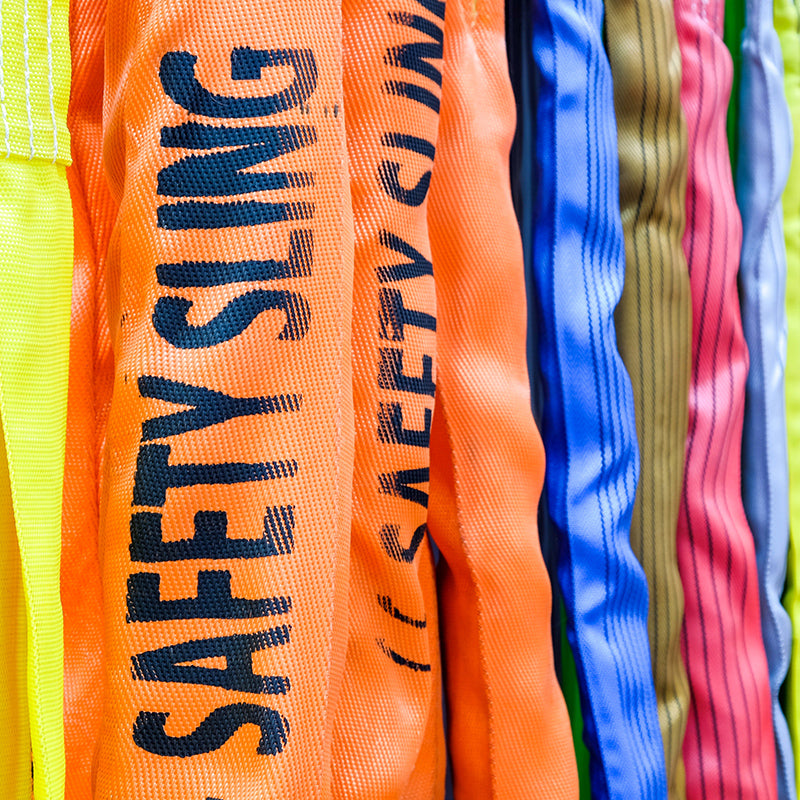
Round slings are endless loop slings constructed from continuous high-tenacity polyester fibres enclosed in a woven protective sleeve. The endless loop geometry loads all fibres simultaneously, producing a higher strength-to-weight ratio than flat webbing slings of equivalent SWL. The tubular, cushioned profile creates minimal contact pressure on irregular and round load surfaces.
The Ratchet Shop supplies round slings in SWL ratings from 1,000 kg to 8,000 kg, certified to BSEN 1492-2:2000 with colour-coded identification on every sling. Round slings are available to order in custom lengths and sizes up to 100 tonnes SWL.
4 construction applications specify round slings:
- Mechanical and electrical plant installation — pumps, motors, switchgear, and HVAC units require slings that wrap around irregular profiles without creating flat-edge pressure points
- Pipe and duct lifting — round slings wrap conformally around circular pipe and duct profiles, distributing load across the full contact arc rather than concentrating it at 2 points as a chain hook creates
- Steel fabrication and section lifting — round slings in basket configuration on circular hollow sections and structural tubes prevent deformation at the contact point
- Confined access lifts — the compact, flexible profile of a round sling passes through restricted access openings, service shafts, and ceiling voids where flat webbing slings cannot be positioned
What Hitch Configurations Are Used for Construction Lifts?
3 hitch configurations apply to lifting slings on construction sites, each producing a different effective SWL:
- Vertical (straight) hitch: the sling runs straight from the hook to a single attachment point. Mode factor 1.0, so the effective SWL equals the WLL marked on the label.
- Choker hitch: the sling is passed around the load and back through its own eye, tightening as it lifts. Mode factor 0.8, so a 2,000kg sling lifts a maximum of 1,600kg choked.
- Basket hitch: the sling cradles the load with both eyes on the hook. Mode factor 2.0 when the legs hang parallel, 1.4 when the legs are between 0° and 45° from vertical, and 1.0 between 45° and 60°. Never use a sling at more than 60° from vertical.
Always read the mode factor table on the sling label before every lift, and work out the effective SWL for the hitch you plan to use, not just the figure printed for a straight lift.
Conclusion
Webbing slings protect finished surfaces and spread the load across a wide contact face, while round slings handle heavier, awkward and confined lifts. Matching the sling type and hitch to the load keeps construction lifts safe and compliant with LOLER. Browse our webbing slings and round slings, or contact us for help choosing the right sling for your site.


