


Contents7 sections
Yes, you can, but you need to learn about how to use lifting slings safely while being stranded in the middle of the road.
It is the question that makes tow truck operators curious about whether the equipment that is used in lifting and loading in construction, manufacturing, logistics, and shipment, can be utilised to tow a car? It is suggested that, without knowing anything at all, it is better to read the instructions on the equipment.
Through this blog, you will learn how to take advantage of towing with lifting slings to normalise the situation.
What are Lifting Slings?
Lifting slings are made from nylon and polyester. This equipment serves as a link between what is being lifted (the object) and with what that load is being lifted (a lifting hook). There are two types of lifting slings: webbing slings and round slings.
Webbing slings are made from polyester, which are ideal for lifting objects that are easy to lift without any complexities. Furthermore, because of its wide webbing design, it is considered best for delicate or smooth surfaces.
Danger: As their polyester is exposed, the chances of abrasion are high.
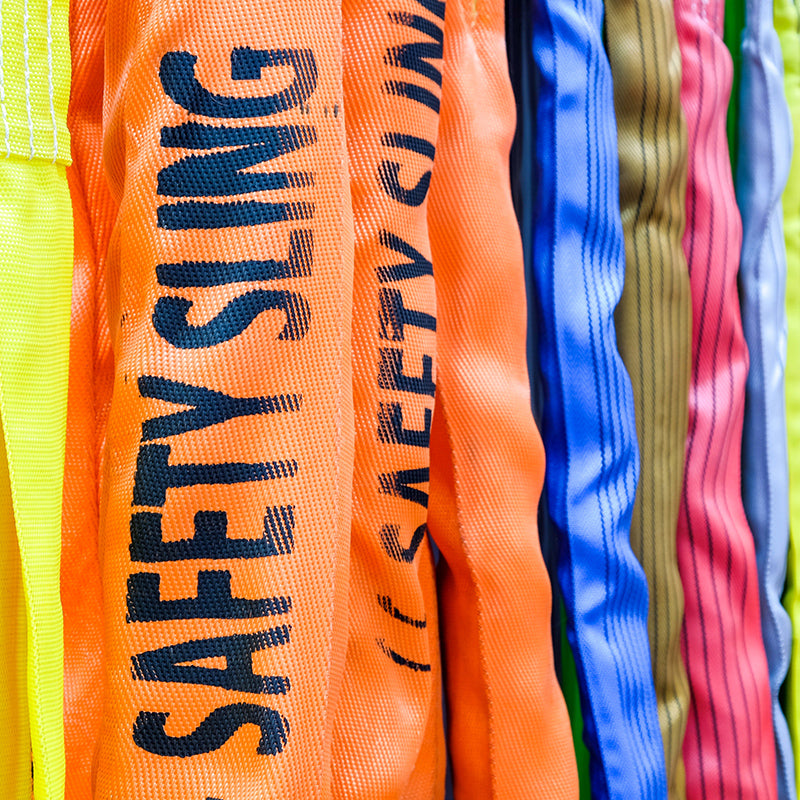
On the other hand, round slings are made from polyester fibre that is woven in an endless loop and protected in a polyester jacket. You can use it to tie around a cylindrical object like a pipe with shackles. They are considerably more flexible than webbing slings. Most importantly, it is usable for irregular loads.
Danger: Avoid the edges while using any sling, whether round or webbing.
How Lifting Slings Work for Towing Vehicles
Just as mentioned above, lifting slings serve as a connection between the car being towed and the towing vehicle when an automobile is being towed. They can withstand a great deal of strain without breaking since they are composed of durable polyester fibres.
By distributing weight uniformly throughout their surface, these slings lessen the pressure on connection points. When towing a car, this consistent load distribution is essential, particularly if the vehicle is stalled or needs to be moved across an uneven surface.
Compared to stiff metal chains, polyester's suppleness helps absorb shocks and jerks, making towing safer and more comfortable.
But still, the confusion resides regarding that scenario, what type of lifting sling would be appropriate?
Choosing the Right Type of Sling for the Job
Selecting the proper lifting slings for car towing is crucial. Webbing slings and circular slings are the two most popular varieties available at The Ratchet Shop; they are both made of strong polyester but have different shapes, sizes, and colours.
Webbing slings are quite good at pulling cars, especially short distances or on flat ground, as they have a wide surface and two loop eyes. Additionally, its flat form helps shield the paint and structure of your car from scratches.
Conversely, round slings are more flexible and rounder. They are helpful for lifting or pushing from difficult angles since they can readily wrap around various elements of a vehicle. So, they are selected for situations where flexibility is important, including off-road recovery or rocky surfaces.
The usage of these lifting slings highly depends upon the situation, but it is good if you check the load capacity and its condition before using it. Because even a small cut can result in serious consequences.
Check the Sling’s Weight Capacity Before Towing
A working load restriction of lifting slings, often expressed in kilograms or tons. The amount of weight it can safely support is indicated by this rating. Failure or damage may result from using a sling that is not strong enough to support the weight of your car.
For instance, you should pick a sling that can support at least 1,500 kg if your automobile weighs that much. At The Ratchet Shop you can get round slings that typically weigh between 1,000 and 8,000 kg, whereas webbing slings can support weights between 1,000 and 10,000 kg. For extra safety, always choose a sling with a higher rating.
Notice: Avoid buying without understanding the load limits of lifting slings. Reading a blog on this will give you a clear idea regarding what will be appropriate for you.
Durability That Makes a Difference
While pulling a car as a tow truck operator, you do not want to face a situation where suddenly your lifting sling becomes damaged. The material is important because of this. Polyester lifting slings of The Ratchet Shop are renowned for their flexibility, strength, and resistance. Even when exposed to water, oil, or grease, they do not deteriorate, stretch, or lose their strength.
Their longevity and dependability, even in outdoor settings, are further enhanced by their resistance to the majority of acids and UV protection. So, polyester lifting slings for car towing remain strong and reliable in any weather conditions, including mud, rain, and heat.
Safety Tips for Towing with Lifting Slings
If done properly, towing an automobile with lifting slings can be safe.
- Before using your slings, always check them.
- Look for indications of fraying, cuts, or wear. Even a tiny tear can weaken the sling and make towing dangerous.
- Next, properly fasten the sling. Make sure it is fastened to sturdy areas of both cars rather than bumpers or other potentially brittle or bending pieces. The sling must be tight and free of knots or twists.
- Lastly, tow steadily and slowly. The sling may break due to strain from abrupt shocks or fast acceleration. Hence, the secret to ensuring the safety of both cars is to proceed smoothly and gradually.
What are the questions that people have for The Ratchet Shop?
Is it safe to tow a car using lifting slings?
Yes, it’s safe to tow your car with lifting slings if you use the right type and weight capacity. Always check that the sling is in good condition and rated higher than your vehicle’s weight. Secure it properly and tow slowly to avoid sudden jerks.
Which type of lifting sling is best for towing a car?
Both webbing and round slings can be used for towing. Webbing slings are flat and stable, making them great for towing on smooth roads. Round slings are more flexible, ideal for uneven or off-road surfaces. So, while towing with lifting slings, choose one if you want everything to be perfectly done.
How do I know if a lifting sling can handle a car’s weight?
Each sling has a working load limit mentioned on its label or tag. Check your car’s weight and make sure the sling’s capacity is equal to or greater than that number. Using a higher-rated sling adds extra safety.
Can lifting slings damage a car’s body or paint?
No, lifting slings are made from soft polyester that’s gentle on surfaces. Unlike chains or ropes, they don’t scratch or dent your car. Just ensure the sling is clean and free from debris before attaching it.
What should I check before using a lifting sling for towing?
Inspect the sling for cuts, fraying, or wear before use. Make sure the connection points are strong and secure. Avoid knots or twists, and never use damaged slings; they can break under pressure and cause accidents.
Conclusion
So, can you use lifting slings to haul your car? Absolutely, as long as it's done correctly. These slings are a dependable option for pulling cars of all sizes because they are strong and weatherproof.
Car towing may be made easy, quick, and damage-free by selecting the appropriate sling type from The Ratchet Shop, verifying its weight limit, and following basic safety precautions. An excellent polyester lifting sling can be the trustworthy ally you require for any situation, including off-road recovery or roadside emergencies.
Ultimately, transferring your car from one place to another isn't the only goal; you also need to consider the safety of the vehicle when towing with lifting slings. So, at The Ratchet Shop you can select the proper type of sling with an accurate weight limit, and it will be delivered the next day.


