


Contents7 sections
A lifting chain in continuous industrial use accumulates wear at a rate of 0.1mm to 0.3mm of link diameter reduction per 500 operating hours under normal load conditions, based on LEEA inspection data for Grade 80 alloy steel chains. A 10mm chain link worn to 9mm has lost 19% of its original cross-sectional area and must be withdrawn from service immediately under BS EN 818-4 criteria. Maintenance is not an optional inspection task. It is the process that determines whether a certified WLL remains valid between LOLER thorough examinations. This guide covers the 6 core maintenance tasks, component-level inspection criteria, lubrication schedules, storage requirements, and the rejection thresholds that LOLER-competent persons apply at formal examination.
Why Does Lifting Chain Maintenance Matter Under LOLER 1998?
LOLER 1998 Regulation 9 requires every lifting chain to remain in a safe condition throughout its service life. Thorough examination every 6 months identifies defects that develop between inspections. Maintenance between examinations prevents accelerated degradation that reduces WLL below the certified rating before the next examination date.
3 failure modes develop specifically between formal LOLER examinations:
- Corrosion progression — surface rust converts to pitting corrosion within 4 to 8 weeks of exposure in humid environments without lubrication. Pitting reduces link cross-sectional area below the 10% wear threshold before visual inspection detects it
- Fatigue crack initiation — microscopic cracks develop at the bearing contact points between links under repeated loading. Lubrication reduces bearing surface friction by 30% to 40%, directly reducing fatigue crack initiation rate, as referenced in LEEA Code of Practice 6
- Stiff link formation — dry link contact surfaces bind under load, preventing the chain from returning to its natural hanging geometry. A stiff link concentrates load at the binding point, creating a local stress riser that reduces WLL at that location
All 3 failure modes are preventable through scheduled maintenance. None are detectable by the chain user without close physical inspection.
What Does a Pre-Use Lifting Chain Inspection Cover?
Pre-use inspection covers 6 check points on every lifting chain assembly before each lift, as required by LOLER 1998 and LEEA Code of Practice 6:
- Link wear measurement — check each link for visible diameter reduction. A link worn beyond 10% of the original diameter, confirmed by caliper measurement at the bearing contact zone, is rejected immediately. For a 10mm Grade 80 short link chain, the rejection threshold is 9mm measured link diameter
- Link elongation check — measure overall chain length against the original certified length marked on the test certificate. A chain elongated by more than 5% of its original length has entered the plastic deformation zone and is withdrawn from service
- Crack and deformation inspection — check each link for cracks at the crown and side bar, and for any bending, twisting, or gouging. A single cracked link renders the entire chain assembly unsafe for use
- Hook inspection — check hook throat opening against the manufacturer's original dimension. A hook with throat opening exceeding 5% of the original measurement is rejected. Check the safety latch engages positively under finger pressure and returns to the closed position without manual assistance
- Master link inspection — check the master link and master link assembly for ovality, wear at the crane hook contact zone, and deformation at the leg attachment points. Ovality exceeding 5% of the original bore diameter is a rejection criterion
- Identification tag legibility — confirm the WLL, chain grade, EN standard, batch number, and test date are legible on the identification tag. A chain with an illegible or missing tag is removed from service until the tag is replaced and traceability is confirmed with the original test certificate
How Do You Lubricate a Lifting Chain Correctly?
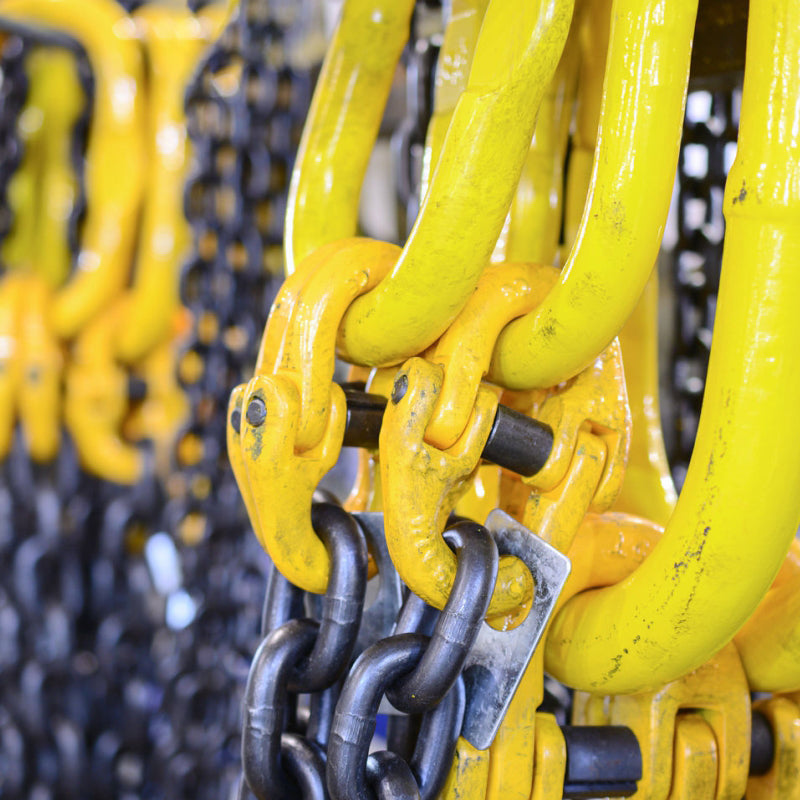
Lubrication protects 3 specific contact zones in a lifting chain assembly: link-to-link bearing surfaces, hook pivot points, and master link contact areas. Each zone requires a different application method.
Link-to-Link Bearing Surfaces
Apply a penetrating chain lubricant to the full chain length, ensuring the lubricant reaches the internal bearing contact zone between interlocking links. Spray lubricants penetrate more effectively than brush-applied grease for link-to-link surfaces. The lubrication interval for lifting chains in outdoor industrial use is every 3 months. Chains operating in wet, acidic, or salt environments require lubrication every 4 to 6 weeks.
Do not use grease on chain link bearing surfaces in environments where fine abrasive particles are present, including foundry, quarry, and demolition sites. Grease traps abrasive particles against the bearing surface and accelerates wear rather than reducing it. Use a dry film lubricant or light penetrating oil in abrasive environments.
Hook Pivot Points
Apply lubricant to the hook shank thread and pivot pin on swivel hooks and self-locking hooks at every pre-use inspection. A dry pivot pin on a self-locking hook causes the latch mechanism to bind under load, preventing full latch engagement. The clevis self-locking hooks and eye self-locking hooks supplied by The Ratchet Shop use a spring-loaded latch mechanism that requires a clean, lubricated pivot to function correctly under load.
Master Link Contact Zone
Apply lubricant to the crane hook contact zone of the master link at every pre-use inspection. The crane hook bears directly on the master link crown under load. Dry metal-to-metal contact at this point causes localised wear that is not visible during a visual inspection without close measurement.
What Are the Correct Storage Requirements for Lifting Chains?
4 storage requirements apply to lifting chains under PUWER 1998 Regulation 7, which requires work equipment to be stored in conditions that do not cause deterioration:
- Store on a dedicated chain rack or hook — hanging storage prevents kinking, coiling stress, and floor contact corrosion. Chains coiled on the floor absorb moisture from concrete and develop surface corrosion within 2 to 3 weeks in unheated storage environments
- Store in a dry, ventilated environment — relative humidity above 70% accelerates corrosion on bare alloy steel chain links. An unheated but ventilated storage area maintains lower humidity than a sealed container or storage bag
- Keep chains away from acids, alkalis, and chemical vapours — alloy steel chain is susceptible to hydrogen embrittlement from acid exposure. A chain exposed to acid cleaning agents, battery acid, or acid vapour requires immediate withdrawal and competent person inspection before any further use
- Retain the identification tag with the chain — never separate a chain assembly from its identification tag during storage. LOLER 1998 requires full traceability. A chain stored without its tag has no verified WLL or examination history and is treated as uncertified equipment
How Do You Maintain Lifting Chain Components?
Individual chain components require maintenance independent of the chain leg. 4 component types need specific maintenance attention:
Connecting Links
Chain connecting links carry the full assembly WLL at the connection point between chain legs and master link. Check the locking pin engagement after every use in dynamic or shock loading environments. A connecting link with a loose or partially engaged locking pin is replaced before the assembly returns to service.
Grab Hooks
Grab hooks shorten chain leg length by engaging a chain link in the hook saddle. Check the saddle contact surface for wear at every inspection. A grab hook saddle worn below 90% of its original depth reduces the contact area and increases the risk of chain link dislodgement under load.
Swivel Hooks
Swivel hooks on single leg and two leg chain assemblies rotate under load to prevent chain twist. Check swivel rotation before each use. A swivel that does not rotate freely under hand pressure requires lubrication at the swivel pin. A swivel that does not rotate after lubrication is replaced.
Master Link Assemblies
The master link assembly on three leg and four leg chain configurations carries the combined load of all legs simultaneously. Check all leg attachment points for wear and deformation after every use involving loads above 75% of the assembly WLL.
What Is the LOLER Thorough Examination Schedule for Lifting Chains?
LOLER 1998 Schedule 1 requires thorough examination of all lifting chains at intervals not exceeding 6 months for chains used in general lifting. Chains used to lift persons require examination every 6 months as a minimum. A competent person specifies a shorter interval based on use intensity, operating environment, and inspection findings.
The thorough examination record includes: chain grade, link diameter, WLL, assembly configuration, examination date, examiner identity and qualification, findings, and next examination due date. Records are retained for a minimum of 2 years. The Ratchet Shop supplies all lifting chains with a Certificate of Thorough Examination and full test documentation establishing the baseline measurements against which all subsequent examinations are compared.
Frequently Asked Questions
Can a lifting chain be re-certified after repair?
No. A lifting chain that has been welded, reshaped, or had links replaced is not re-certifiable under BS EN 818-4. Welding introduces heat-affected zones that alter the metallurgical properties of the alloy steel and invalidate the original certification. Replacement is the only compliant option.
How do I know if a lifting chain has been shock loaded?
Shock loading leaves no consistent visible marker on a chain assembly. A chain that has been shock loaded shows potential elongation beyond 5% of original length. The only reliable indicator is load history documentation. Any chain involved in a dropped load incident, sudden arrest, or unexpected overload is withdrawn and submitted for competent person inspection before further use.
What lubricant is best for Grade 80 lifting chains?
A penetrating chain lubricant with an anti-corrosion additive is correct for Grade 80 alloy steel lifting chains in standard industrial environments. SAE 30 mineral oil applied by spray or brush provides effective link-to-link bearing lubrication. Do not use copper-based anti-seize compounds on Grade 80 chain, as copper accelerates galvanic corrosion in alloy steel in humid environments.
How are lifting chain WLL markings applied?
WLL markings are stamped on the identification tag attached to the master link or master link assembly. The tag includes WLL in tonnes, chain grade, link diameter, EN standard reference, batch number, and test date. Markings are not stamped directly onto chain links in standard Grade 80 assemblies.
Conclusion
Lifting chain maintenance operates on a 3-tier schedule: pre-use inspection before every lift, periodic lubrication every 3 months in standard environments and every 4 to 6 weeks in corrosive or wet conditions, and formal LOLER thorough examination every 6 months by a competent person. Each tier addresses a different failure mode. Pre-use inspection identifies visible defects. Lubrication prevents fatigue crack initiation and corrosion progression between inspections. LOLER thorough examination measures dimensional changes that pre-use visual checks cannot detect.
The 10% link diameter wear threshold and 5% elongation limit are the 2 primary quantitative rejection criteria under BS EN 818-4 and LEEA inspection criteria. Both require caliper measurement, not visual estimation. A chain that passes visual inspection but exceeds either dimensional threshold carries a WLL below its certified value and constitutes an unsafe lifting assembly under LOLER 1998.
The Ratchet Shop supplies lifting chains in single, two, three, and four leg configurations, certified to BS EN 818-4 and tested to 2.5 times WLL before dispatch. Every assembly ships with a Certificate of Thorough Examination, identification tag, and full test documentation establishing the baseline for all future LOLER examinations. For maintenance queries, replacement components, or custom chain assembly specifications, contact The Ratchet Shop directly.


